


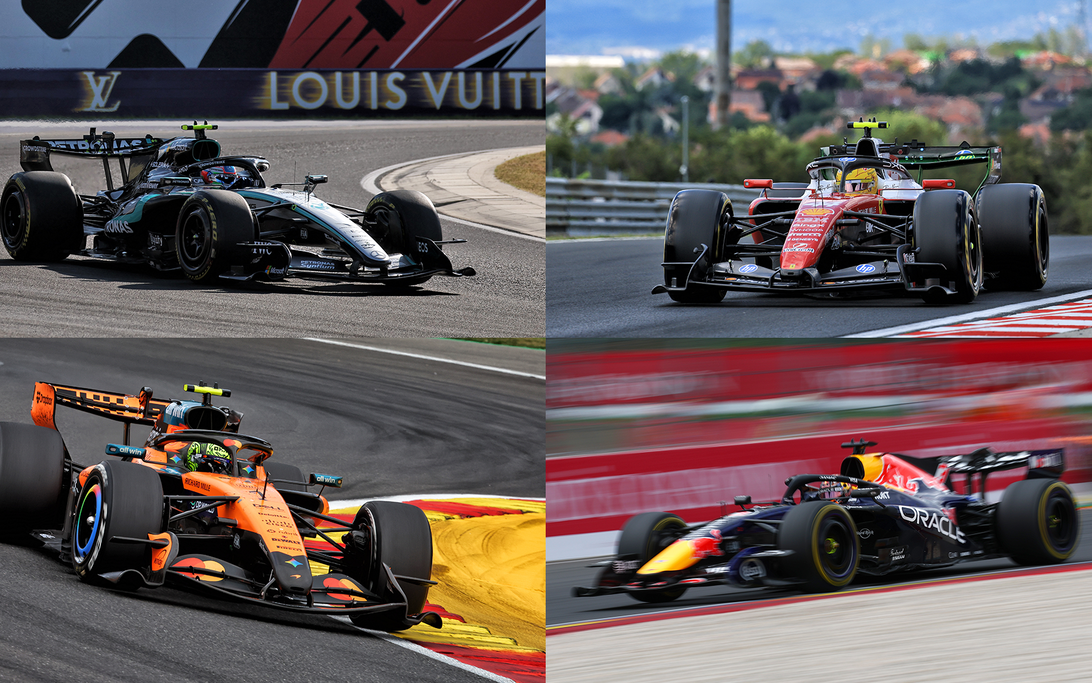
The summer break offers a rare opportunity to step back and assess the technical picture with a clearer head.
It does not allow for a definitive verdict on which upgrades have proven most effective, but it does reveal the design trends that have quietly taken hold across the first half of the championship, with varying degrees of success.
Let us take a closer look at how the top four teams have developed its cars so far this season.
Ferrari SF-26
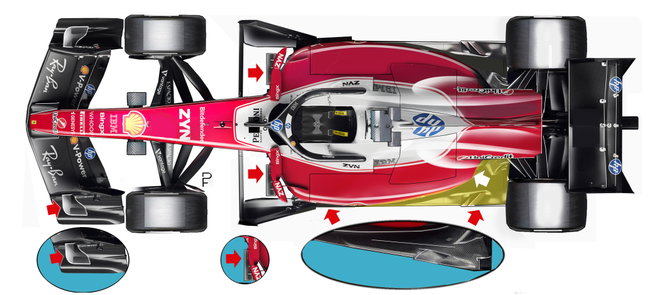
Ferrari has been the most prolific developer on the grid, consistently pushing the SF-26 forward throughout the opening months of the season.
Two innovations in particular have stood out, not merely for their effectiveness but for the influence they have had on rival outfits.
The first is the FTM, or Flip Tail Mode. The concept centres on a curved winglet that partially obscures half of the power unit's exhaust outlet, forcing hot exhaust gases upward and channelling them beneath the main profile of the rear wing.
The result is a significant increase in rear downforce. Crucially, this was not something Ferrari introduced mid-season; it was present from the very first race.
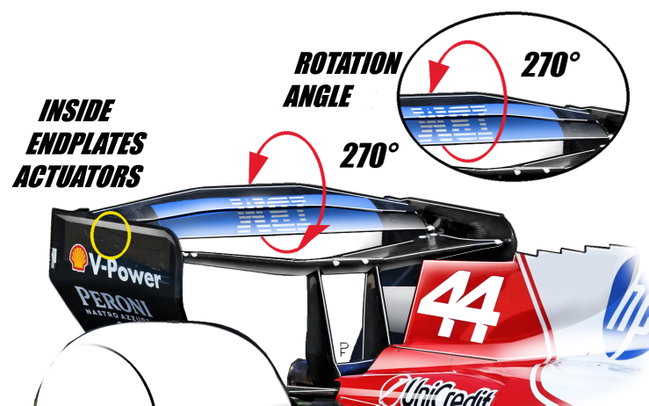
The second innovation is the so-called 'Macarena' rear wing, which drew considerable attention from its initial appearance during the second pre-season test. It made its full-weekend race debut in Miami, alongside the first evolution of the floor.
The Macarena has proved particularly potent on circuits combining long straights with fast, sweeping corners, whilst still permitting the use of higher-downforce profiles in more technical sections.
It is, by any measure, a highly effective solution, though one that has not been straightforward to replicate, as both Red Bull and McLaren have discovered.
McLaren MCL40
The reigning world champions represent the most natural point of contrast to Ferrari's approach, both in philosophy and in the consistency of their development execution.
McLaren arrived in Miami with a substantial upgrade package, which was then supplemented in Canada with a revised front wing. However, the most genuinely transformative step forward for the MCL40 did not come until the Hungarian Grand Prix.
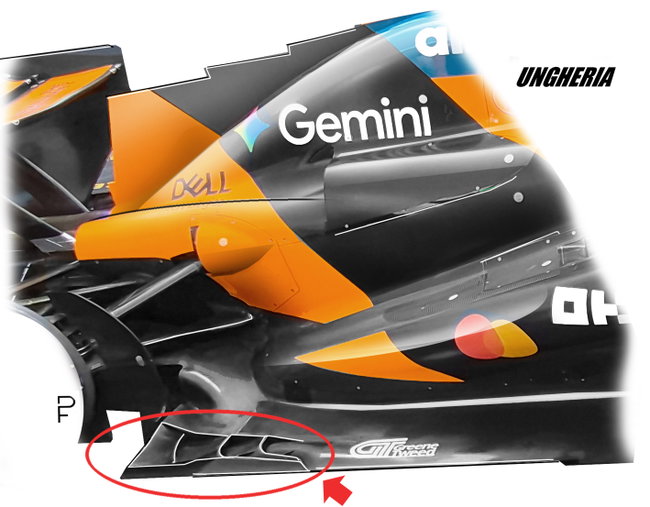
At Budapest, the Woking-based team introduced a radically reworked floor, with significant changes to both its forward section and, most notably, the area ahead of the rear wheels.
The primary aim was to increase the overall aerodynamic load generated by the floor, which had been a persistent shortcoming, compounded in part by the car's relatively short wheelbase. Beyond raw load, the revision was also designed to adjust the distribution of that load to improve overall balance.
McLaren's version of the Macarena rear wing, meanwhile, has yet to appear in its definitive race-ready form, underlining just how demanding a piece of engineering it is to produce at the level Ferrari has achieved.
Red Bull RB22
Of the front-running cars, the RB22 has arguably undergone the most fundamental shift in aerodynamic concept across the first half of the season. Two interventions have been decisive.
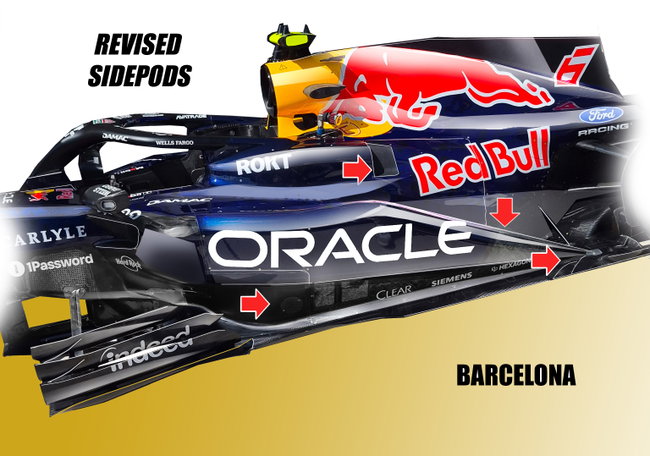
The first came in Barcelona, where the lower section of the sidepods was subjected to a comprehensive redesign.
The revision effectively moved Red Bull's aerodynamic philosophy closer to McLaren's characteristic rear-ramp sidepod arrangement, whilst simultaneously drawing clear inspiration from Ferrari's own sidepod configuration and the floor area ahead of the rear wheels.
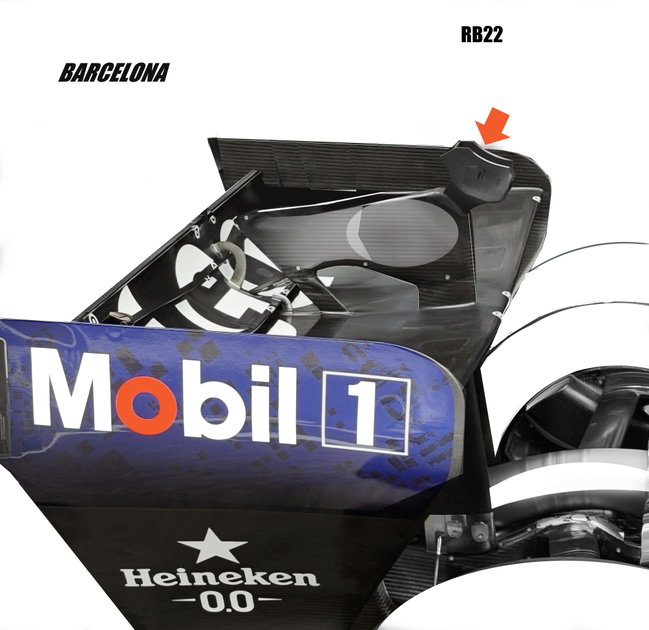
Also notable in Spain was the addition of a mini-flap above the rear-wing actuator fairing, introduced to address a deficit in rear downforce. A pair of similar elements had already appeared at the Monaco Grand Prix, making this something of a logical progression.
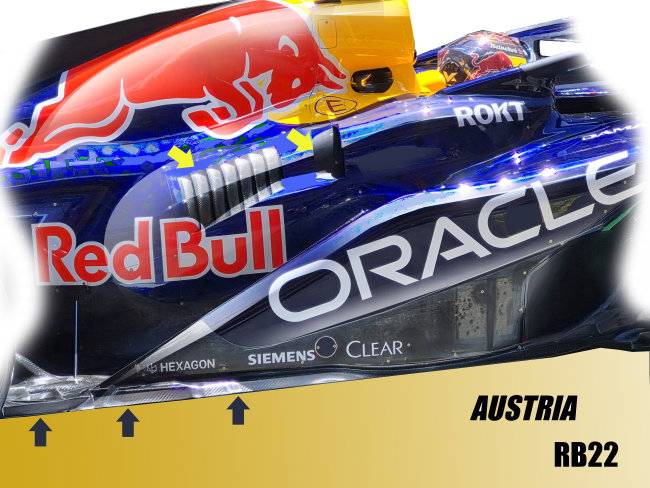
The second significant development came in Austria and was concerned with internal fluid dynamics rather than external bodywork. Changes were made to the radiator inlet openings and, critically, to the internal ducting.
These modifications did not alter the notably compact packaging of the power unit's ancillary components, but they represented a meaningful functional step forward.
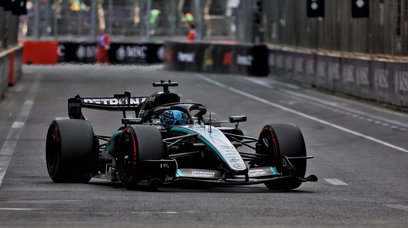
Mercedes W17
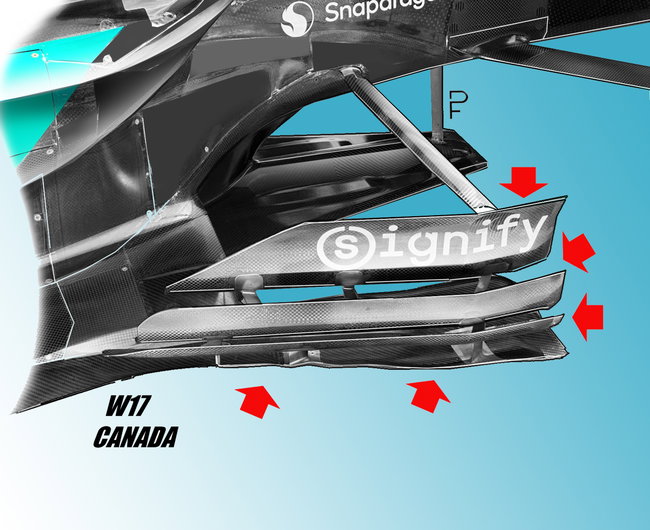
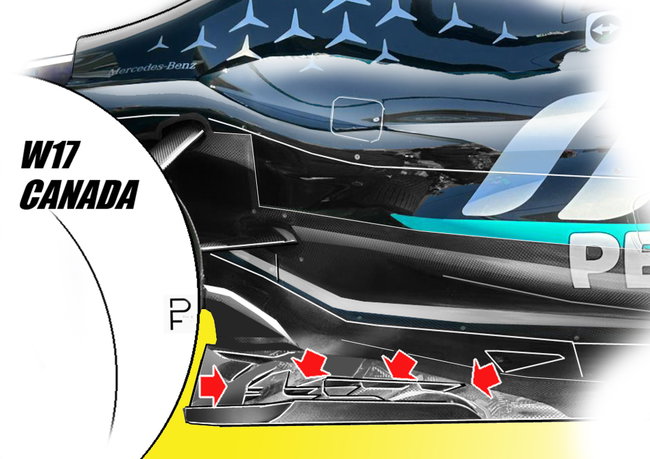
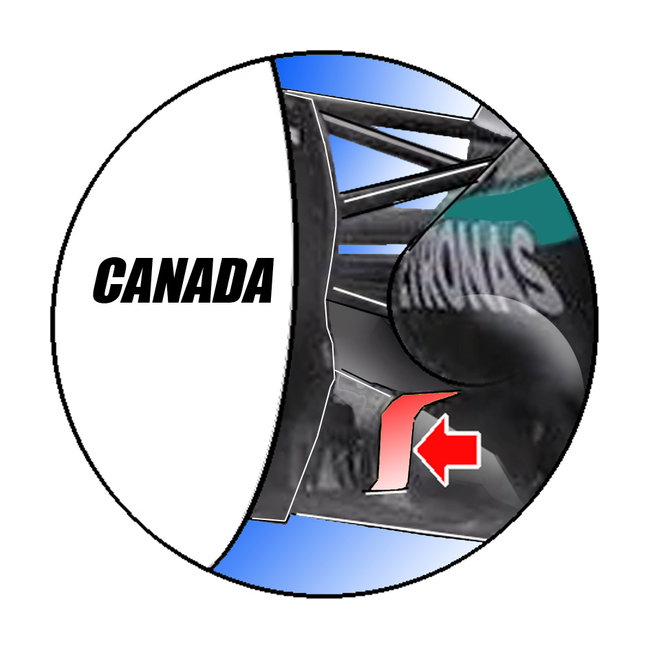
Whilst Mercedes has continued to refine the W17 with updates to the bargeboards, brake ducts and front wing across recent rounds, the most comprehensive and technically interesting development of this car came in Canada.
The floor was heavily reworked in Montreal across virtually every section, beginning with additional elements on the front bargeboards, whose multiple fins were reshaped to improve airflow management.
The central section of the floor also received attention, with a particular focus on the aerodynamically critical area ahead of the front wheels.
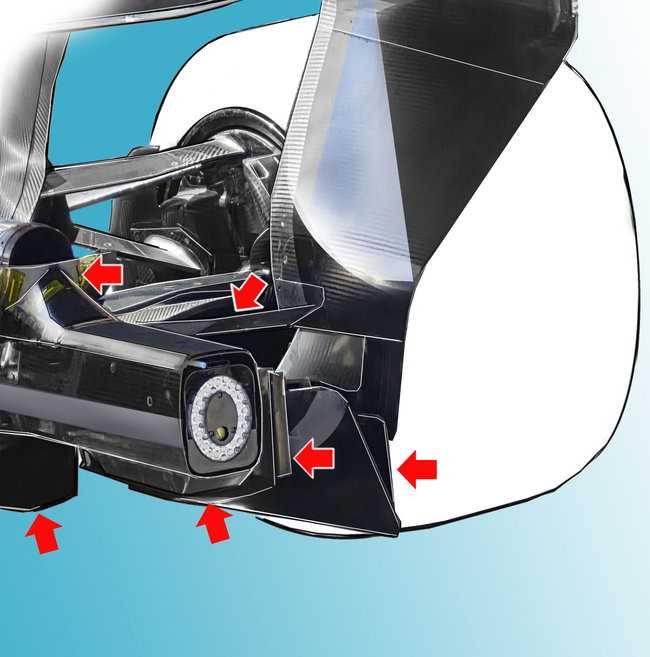
Rounding out the package was an evolution of the diffuser's outer vertical fences, which incorporated a large cut-out designed to enhance extraction through the rear expansion area of the diffuser.
Also interesting:
Join RacingNews365's Nick Golding and Samuel Coop as they dissect the biggest storylines looking ahead to the second half of the F1 season, featuring the likes of Kimi Antonelli, Lewis Hamilton and Max Verstappen.
Rather watch the podcast? Then click here!


Get the latest F1 news from RacingNews365 directly in your Google feed! Click on the link below and you’ll see your favourite F1 website appearing even more often. That way, you’ll never miss any news, analyses, interviews, or exclusives.
Follow RacingNews365 on GoogleMost read



In this article
Never miss a thing from the Formula 1 season! Add the 2026 F1 schedule to your calendar at the touch of a button. Subscribe below and put the dates and times of every race directly on your PC or smartphone, so you don't miss a second from the new season.
Download the F1 calendar Download the F1 calendar
A variant with just the race and qualifying is also available.
Click here to download it..






Join the conversation!