


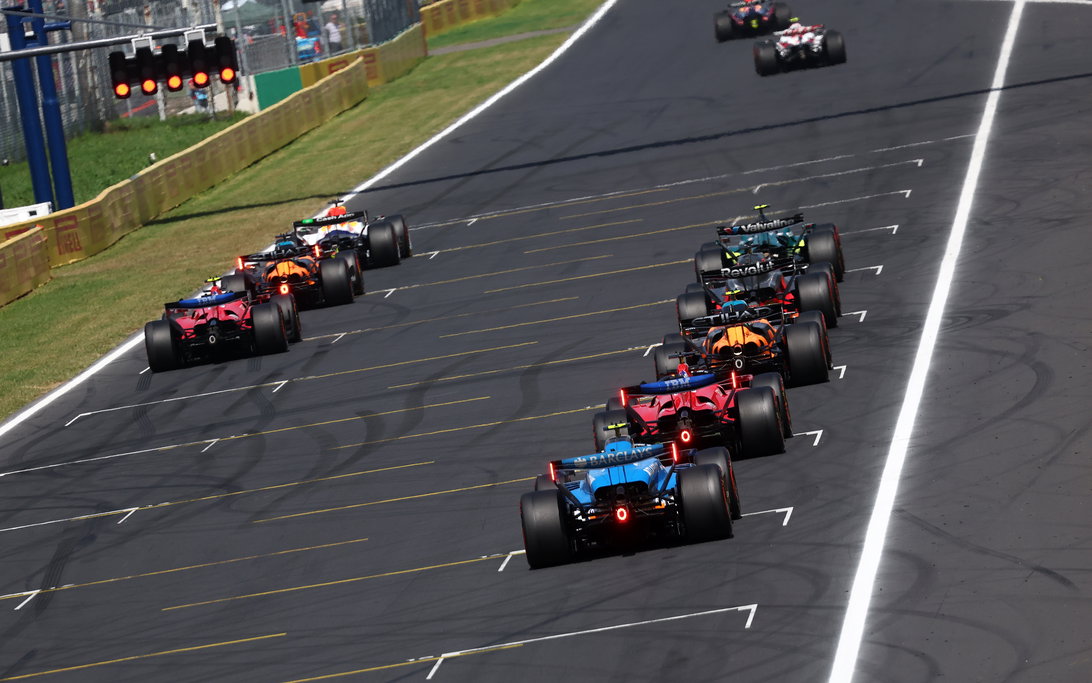
In recent weeks, the discussion about the upcoming new engines in F1 has become increasingly central.
Revived in particular by FIA President Mohammed Ben Sulayem, the proposal to introduce three-litre turbocharged hybrid V8 engines with a maximum deliverable electric power of 100 kW has gained significant traction.
Even from these figures alone, it is clear that this represents a sharp shift away from the massive electrification of the current generation of power units, which, as we have seen since the start of this season, has introduced challenges into the championship primarily related to the management of electrical power, now at 350 kW, which has had a significant impact on the very essence of competition.
Overtaking largely no longer takes place during braking into a corner but, in fact, only on the straights, and is possible only when there is a clear power differential between two cars, through the use of overtake mode. F1 itself appears to be in favour of the new three-litre V8 engines, as it would welcome a simplification of the power units, the possibility of a return to more authentic racing, and a reduction in car weight.
These objectives are likely reconcilable with one another, but it must be noted that, above all, the weight reduction that could result from the adoption of the new power units might not be as significant as expected.
It is indeed correct to point out that a three-litre V8 engine inherently involves an increase in the weight of the crankcase and the pistons themselves, which have a larger diameter than the current ones. This would be partially offset by a substantial reduction in battery volume; however, the batteries would still weigh only slightly less than those used through 2025.
The article continues below.
Viewed by others:
V8 engine return could carry significant weight
It is indeed correct to note that, until last year, the maximum electrical power was 126 kW; therefore, the reduction to 100 kW would not result in a real reduction in battery size compared to the 2025 power units. To some extent, there would be a reduction in the volume of the cooling system, achieved through smaller ERS heat exchangers, but not to the extent that it would allow for a massive reduction in weight. It is equally correct to note that, if the new internal-combustion engines are to deliver significantly higher power output as a percentage compared to current V8s, fuel consumption will also be higher, which will require larger fuel tanks and, in any case, a greater weight of fuel carried at the start of the race than is currently the case.
The decision to adopt, and possibly bring forward to 2030, the new V8 powertrains is therefore based on motivations more closely tied to a more natural form of racing compared to what we see today, namely a race strategy heavily influenced by energy management.
Returning to the weight, but also to the dimensions of the cars, this is, in any case, a goal that the FIA and F1 intend to achieve, but it is important to note that it can be achieved more through the regulations than by a reduction in the size of the cars.
For example, a maximum wheelbase of 330cm compared to the current 360cm could be imposed, which would in fact allow for a substantial overall reduction in the weight of the cars, and at the same time a radical reduction in their external dimensions, making them more nimble than the current machines.
In essence, the issue of the new engines is clearly a hot topic, as it has substantial implications for the concept of on-track racing and for car designs.
At the same time, as is often the case with initial ideas or draft proposals, the final decision-making process regarding the return to V8 engines is likely to undergo various adjustments to prevent F1 manufacturers from opting for alternatives.
At the same time, the FIA makes no secret of its goal, shared with F1 itself, to promote, through the introduction of less complex engines, especially in terms of electronic management, the arrival of independent PU suppliers, who would effectively take on the role that Cosworth had played for several decades during the era of naturally aspirated F1 engines.
Also interesting:
Join RacingNews365's Ian Parkes, Sam Coop and Nick Golding as they look back on the Bahrain GP in Malaysia, but also look ahead to this weekend's race in Singapore. The confusing and shocking start is a major talking point as is Red Bull's rise.
Rather watch the podcast? Click here!


Most read
In this article
Never miss a thing from the Formula 1 season! Add the 2026 F1 schedule to your calendar at the touch of a button. Subscribe below and put the dates and times of every race directly on your PC or smartphone, so you don't miss a second from the new season.
Download the F1 calendar Download the F1 calendar
A variant with just the race and qualifying is also available.
Click here to download it..





Join the conversation!