


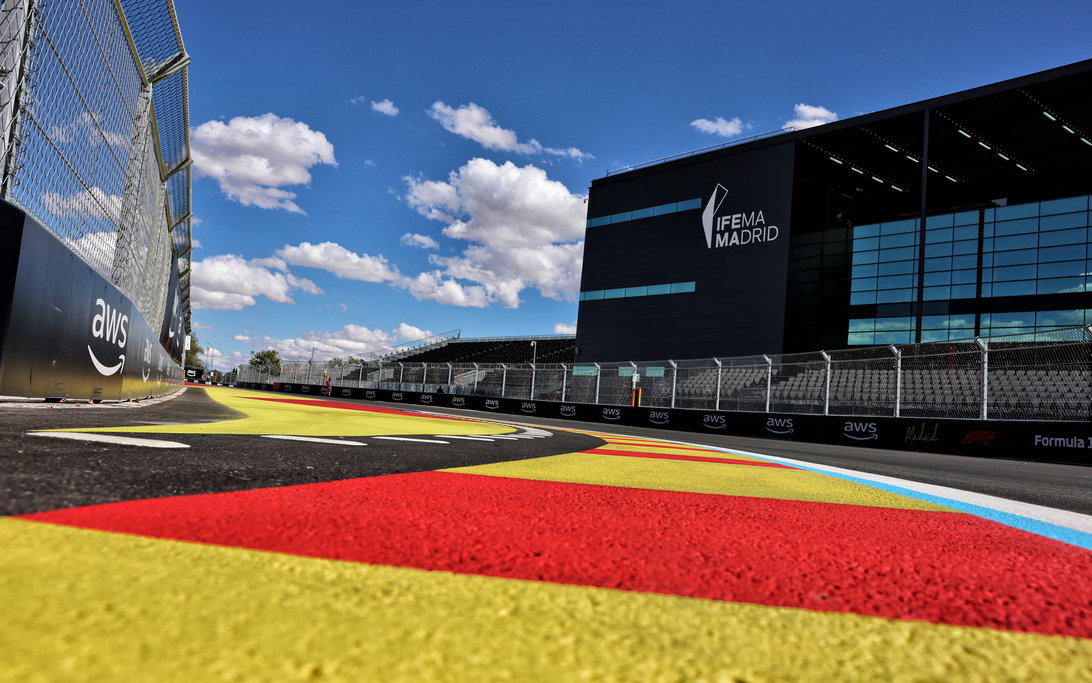
F1 visits a brand-new race track this weekend, with the Spanish Grand Prix moving to Madrid and the Circuito de Madring.
The high-speed track had its first official test last month when Formula 3 held a two-day event - and at it, there were 11 red flags for incidents involving a hit against the barrier.
A handful of drivers have noted the challenge that they are likely to endure to stay out of the barrier, while Williams team boss James Vowles labelled the track a “car killer”.
With the race weekend just around the corner, which sections of the track are likely to cause issues?
If there’s one spot on the Madring that has caused the most crashes, it’s the chicane at Turns 5 and 6. After a run of over 800 meters, during which the F1 cars reach speeds of up to 340 km/h, drivers must brake hard to slow down to about 80 km/h.
The combination of this hard braking, a tight chicane, and minimal run-off areas makes this the ideal spot for mistakes. During the F3 test, a high number of incidents occurred here.
Immediately after this chicane comes Turn 7, the highest point of the circuit at an elevation of about 697 meters. It is a blind turn over a ridge with a wall that is alarmingly close to the exit.
With the already minimal margin for error and the fact that drivers cannot see the apex while braking, promises plenty of incidents in which drivers hit the wall instead of the apex.
Later in the lap comes Turn 17, a sharp 90-degree turn that leads into a tunnel under the M-11 highway. Concrete walls run close to the track both before and after the turn, while limited visibility makes this section particularly treacherous.
Furthermore, drivers approach this section coming off Turns 14 and 15, where aerodynamic load is already high and turbulent air can reduce the car’s stability. Several crashes during the F3 test underscored the danger of this section.
The iconic Turn 12, “La Monumental”, with its 550-meter length and 24 per cent banking, is the circuit’s signature feature. During the F3 test, virtually nothing happened in the turn.
Nevertheless, it remains a potentially dangerous spot: cars pass through here at around 300 km/h and are subjected to enormous lateral forces for about five seconds. The danger of La Monumental, therefore, lies not so much in the likelihood of a crash, but rather in the severe consequences should a crash occur.
 Spanish GP
Also interesting:
Join RacingNews365's Ian Parkes, Samuel Coop and Nick Golding as they look back on the Italian GP and look ahead to Madrid! Kimi Antonelli's incredible win is a main discussion, as is Lewis Hamilton's frustration with Ferrari.
Rather watch the episode? Click here!


Most read






In this article
Never miss a thing from the Formula 1 season! Add the 2026 F1 schedule to your calendar at the touch of a button. Subscribe below and put the dates and times of every race directly on your PC or smartphone, so you don't miss a second from the new season.
Download the F1 calendar Download the F1 calendar
A variant with just the race and qualifying is also available.
Click here to download it..





Join the conversation!