


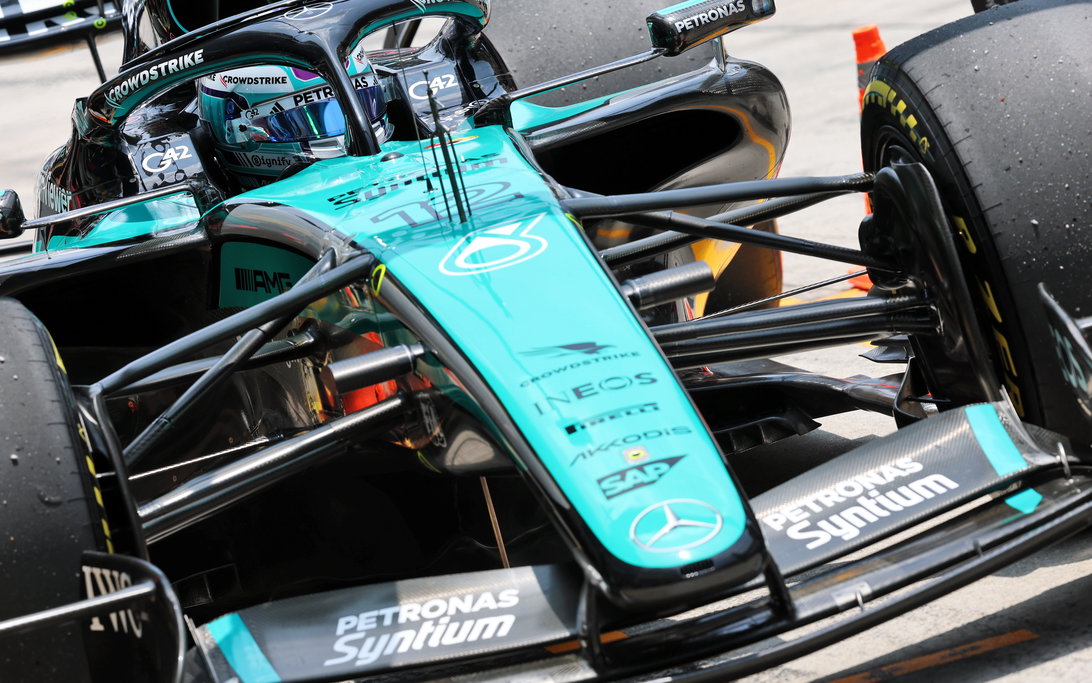
As always, the results from the two free practice sessions on the first day of the Bahrain Grand Prix in Malaysia should be treated with a degree of caution.
Nevertheless, what emerged, particularly from Mercedes in FP2, where the team was running a heavily revised car from an aerodynamic perspective, surprised many members of the paddock at the Sepang International Circuit.
George Russell and Kimi Antonelli finished seventh and eighth, respectively, around half a second behind Charles Leclerc, who topped the timing boards.
FP1 was essentially used to validate the new development package, represented primarily by new sidepods and a revised floor.
The team conducted constant-speed runs to gather useful data on track, which could then be compared with the predictive data from the simulations.
Therefore, it was no surprise that neither W17 had made a particular impression and, above all, that its actual race pace could not be properly assessed.



The mission for FP3
The situation was different, however, in the second free practice session. Both Russell and Antonelli tried various dynamic adjustments — namely suspension changes — as well as modifications to flap angles, without actually finding a satisfactory solution.
In practice, the dynamic response of the W17 to the new aerodynamic maps — namely the distribution of the downforce generated — was not consistent with what had been shown in the simulations.
Simply put, Mercedes could not strike a satisfactory balance, one that would allow either driver to extract the maximum performance from the car.
This may have been partly influenced by the fact — although this applies to everyone — that the track is subject to quite significant evolution due to the characteristics of the circuit and asphalt, compounded by the high ambient temperatures.
The fact remains that, ahead of FP3 and, above all, qualifying, the team's engineers have to start from scratch in determining the correct setup for the W17, having effectively failed to gather any clear reference points during the first day.
It is a complex challenge, but not an impossible one. In any case, it demonstrates how the introduction of large development packages is not always without its difficulties, particularly when the modifications alter the distribution of the downforce generated by the car, as is the case here.
This does not, however, mean that the evolution brought to Sepang does not work and should therefore be rejected.
Essentially, these are integration issues between the 'old and new', requiring an understanding of the W17's behaviour, which is different from before, in order to find new parameters that can be used for the setup.
Most read




In this article
Never miss a thing from the Formula 1 season! Add the 2026 F1 schedule to your calendar at the touch of a button. Subscribe below and put the dates and times of every race directly on your PC or smartphone, so you don't miss a second from the new season.
Download the F1 calendar Download the F1 calendar
A variant with just the race and qualifying is also available.
Click here to download it..





Join the conversation!