


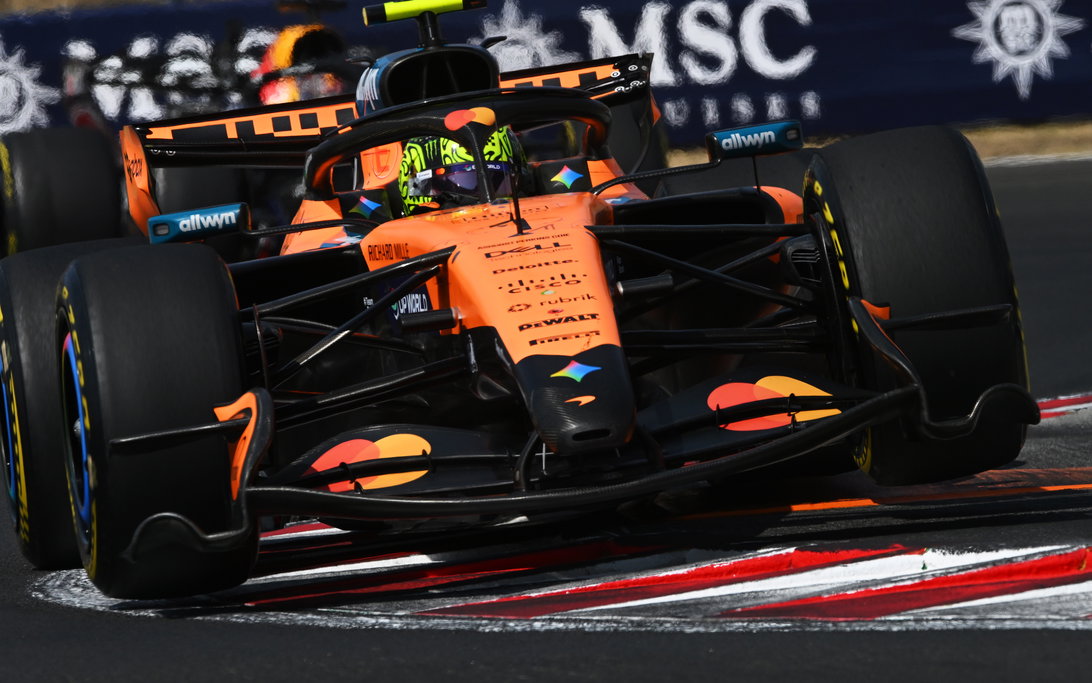
McLaren boss Andrea Stella has explained that the team is not "surprised" at the complexity of developing its own 'Macarena' style rear-wing for use after Ferrari's long development.
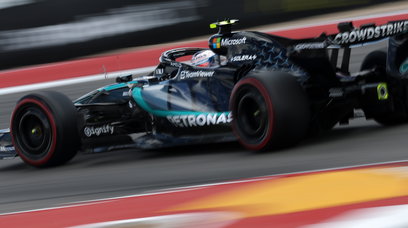
During Bahrain pre-season testing, Lewis Hamilton deployed the eye-catching design, where the rear-wing flap element rotates 270 degrees to open and close, as opposed to the old-style DRS flap opening.
The idea is to generate lift on the straights and boost top-end straight-line speed, whilst dumping more drag, and works akin to an upside-down aircraft wing.
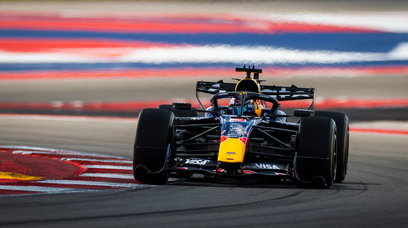
Ferrari then tested the system in practice for the Chinese GP, before it was formally introduced at the Miami GP, where Red Bull also added the wing to its RB22.
Ferrari and Red Bull's versions of the wing work in different ways, with Red Bull's Max Verstappen suffering crashes in Austria qualifying and in the British GP after the airflow failed to reattach in time after straight mode was closed and corner mode re-activated.
The wing was withdrawn in Belgium before being re-introduced in Hungary, with Ferrari having no problems thus far.
As for Stella's McLaren, the team initially brought the part to Montreal, but it was not used, and was only used for the first time on Oscar Piastri's car during FP1 in Hungary.
Charting the "delicate" process behind evaluating the effects of the wing, Stella explained how McLaren was left in no doubt as to the significance and complexity of the project after witnessing Ferrari's development time.
"The project with the rotating flap is, I have to say, a complicated project," Stella told media, including RacingNews365.
"It was no surprise because when we saw Ferrari introducing the wing in the Bahrain test, and then testing it in China, it took a few more events to actually being in condition to race, and we knew it was going to be a complicated project, so I have to say that our engineering department has delivered this project in a way that looks well-behaved, like the wing in terms of mechanical actuation times.
"There are some limitations in the regulations, not only for aerodynamic reasons, but also for the overall behaviour from an aerodynamic point of view, the reattachment, and the time it takes the car to regain the load.
"It is not only the wing, but the load on the wing is also the load on the entire car as driven from the car, and all this, I have to say, has been pretty consistent with expectations, so it has been a positive sign-off of the concept, and we look forward to introducing this concept at future events.
"There was a question about the comparison with Red Bull, and I don't think the wind tunnel is a major factor in terms of determining the aerodynamic behaviour of re-attachment.
"I think you can use other tools for that, and then the most important tool, especially when you have this sort of complicated project, remains what you observe at the track.
"So it was important for us to acquire data trackside, because we would never have relied on a wind-tunnel only for such a delicate project."
Also interesting:
Join RacingNews365's Nick Golding and Samuel Coop as they look ahead to this weekend's Dutch Grand Prix. Kimi Antonelli's title charge, Lando Norris' strong recent form, if George Russell can bounce back and Max Verstappen's return home are all discussed!
Rather watch the podcast? Then click here!


Most read


In this article
Never miss a thing from the Formula 1 season! Add the 2026 F1 schedule to your calendar at the touch of a button. Subscribe below and put the dates and times of every race directly on your PC or smartphone, so you don't miss a second from the new season.
Download the F1 calendar Download the F1 calendar
A variant with just the race and qualifying is also available.
Click here to download it..





Join the conversation!