


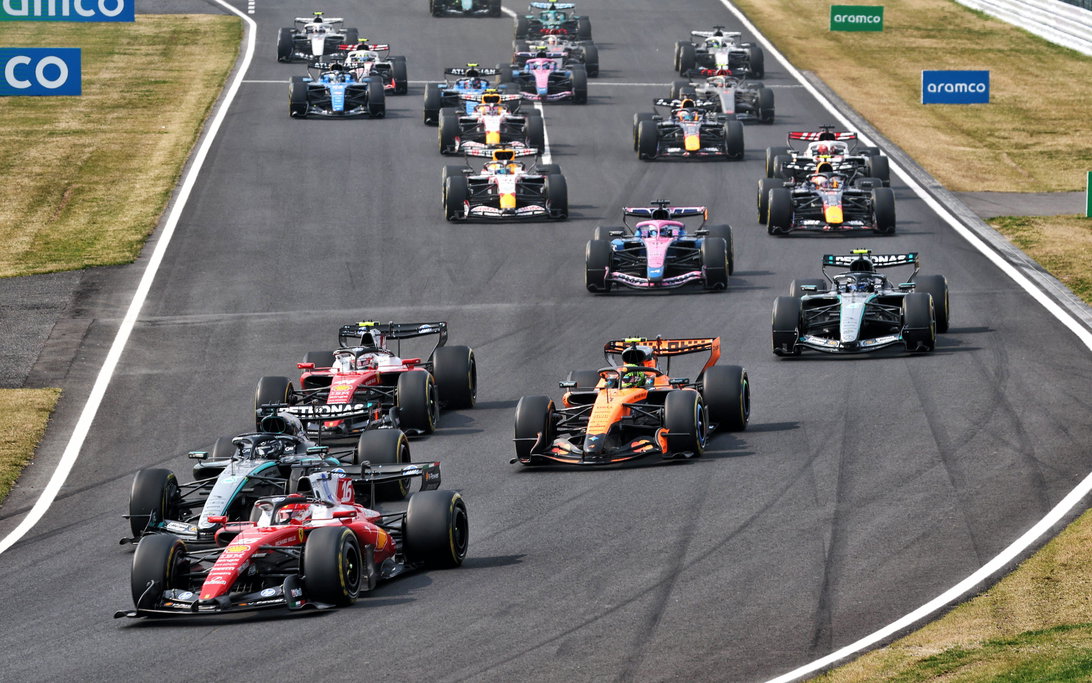
McLaren boss Andrea Stella is keen for a potential increase in the super-clipping charging limit for F1 cars, to combat a perceived bigger safety threat.
Throughout the current April break, a series of meetings is taking place, involving the FIA, F1, the teams, and the power unit manufacturers to look for solutions to the problems which have arisen across the first three grands prix.
Super clipping has become a major talking point. In essence, it is a method of charging the batteries whilst still on full throttle and with straight mode activated, but the system is capped at 250kw with cars capable of producing 350kw of power.
To 'top up' the system to the full state of charge, drivers employ the 'lift and coast' technique of lifting into corners instead of attacking flat out - something which has serious safety implications over the closing speeds involved.
The first meeting between all parties was held on Thursday, April 9th, with an FIA statement confirming that more talks are to be held later this month.
The technical regulations are set to be discussed further on April 16th, before a "high-level" summit on April 20th, where decisions are expected to be made regarding the implementation of rule changes for the Miami Grand Prix.
Any such changes remain subject to formal ratification from the World Motor Sport Council (WMSC).
Speaking of the meetings after the huge Oliver Bearman accident in the Japanese GP, in which the Haas driver sustained a 50G impact following a 30mph closing speed incident with Franco Colapinto's energy-less Alpine, McLaren chief Stella reiterated his demand from pre-season testing that an increase in the super clipping limit was considered - something McLaren did test in pre-season, to the 350kw battery limit.
"I think we have to look at the data and the teams should share information in terms of what was going on with [Franco] Colapinto and Oliver Bearman," Stella told the media, including RacingNews365.
"The reason for adding a 350kw super clip is that we would like to avoid drivers having to lift and coast, because if there is a lift and coast, there's an even bigger speed differential with the car that is following.
"It is a case which should be studied with a certain level of analytical approach, and I don't think a simple solution exists, but we have the expertise, the engineers and the variables to be put in place.
"I think it will be looked at in the meetings with the FIA, the teams, and F1 during the break, and as I've said before, this should jump to the top of the agenda.
"It is difficult for me to say we should do this in a simple way, because as I said, it may be a combination of things which are required and not a simple one."
Also interesting:
Join RacingNews365's Nick Golding and Sam Coop as they dissect the biggest talking points in the world of Formula 1! In this week's episode, the start of the FIA's meetings over the new regulations is discussed, as is whether F1 would miss Max Verstappen.
Rather watch the podcast? Then click here!


Most read




In this article
Never miss a thing from the Formula 1 season! Add the 2026 F1 schedule to your calendar at the touch of a button. Subscribe below and put the dates and times of every race directly on your PC or smartphone, so you don't miss a second from the new season.
Download the F1 calendar Download the F1 calendar
A variant with just the race and qualifying is also available.
Click here to download it..






Join the conversation!