


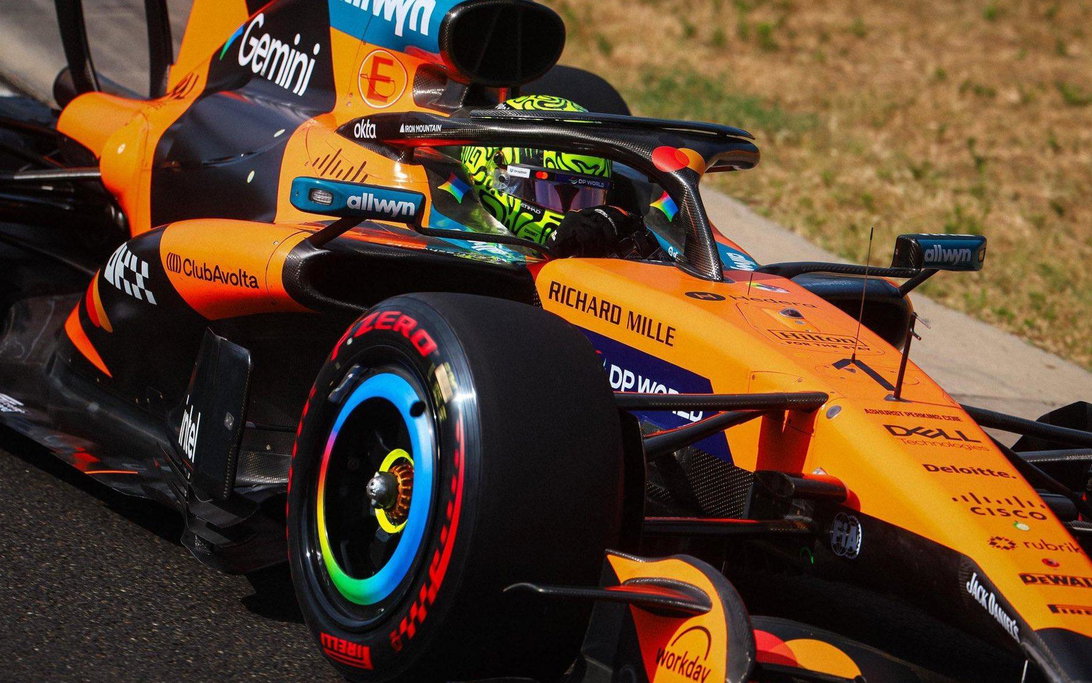
Lando Norris managed to snatch pole position at the Hungarian Grand Prix from Ferrari, with his MCL40 0.012s faster than Lewis Hamilton's SF-26, who then received a three-place demotion for impeding Oscar Piastri.
McLaren's performance is only partly surprising, as the characteristics of the Hungaroring track tend to favour manoeuvrability and traction, qualities intrinsic to the design of the Woking-based team’s car, which features the shortest wheelbase on the grid.
That said, one factor that has undoubtedly contributed to a noticeable improvement in performance is the latest version of the car’s underbody. One of the critical factors for this car since the start of the season has been load distribution, or rather a lack thereof, resulting in part, but not solely, from the short wheelbase.
The decision to adopt an extremely short wheelbase should be viewed not so much as a choice aimed at achieving a specific vehicle dynamic, based on the resulting improved handling, but rather as an immediate conceptual solution to the weight issue that the 2026 cars faced.
Teams had to balance the reduction in minimum weight of 768 kg with the increased energy management challenges of the new beefed-up batteries.
By shortening the wheelbase, the team in Woking believed they had resolved the weight issue at its root; however, the short wheelbase consequently led to significant instability in the car and made it hypersensitive to changes in the balance between the front and rear axles.
This version, therefore, has increased airflow extraction in the section at the base of the diffuser and should thus ensure better balance even on different tracks.
However, only definitive confirmation of the corrections can be made until the car is tested around high-speed circuits, such as Monza, as the teams seek to ensure it can generate greater downforce points.
It’s important to note that the key factor here is ride height, which varies significantly depending on whether the tracks are faster or slower and the associated mechanical setup choices.
In Hungary, the suspension setup is significantly less stiff compared to other faster circuits and, at the same time, slightly higher ride heights are used to better navigate the curbs at the Hungaroring.
It’s worth noting, however, that McLaren debuted its version of the “Macarena” wing here, which is expected to be introduced at Monza, as the advantages it offers are significantly amplified on fast circuits like those in Italy and Azerbaijan.
This will therefore be another factor that, alongside the underbody introduced this weekend, could give this car a different character, a car that the team, through substantial effort, is trying to transform into a more well-rounded machine than it has been since the start of the season.
Most read



Never miss a thing from the Formula 1 season! Add the 2026 F1 schedule to your calendar at the touch of a button. Subscribe below and put the dates and times of every race directly on your PC or smartphone, so you don't miss a second from the new season.
Download the F1 calendar Download the F1 calendar
A variant with just the race and qualifying is also available.
Click here to download it..





Join the conversation!