


Red Bull's progress across the course of this F1 season so far tells a clear story. A car that was nowhere near competitive in March has become one that finished just 4.3 seconds off the win in Madrid at the weekend.
Comparing the results from Melbourne through to Spain shows a team that has clawed its way forward, even if plenty of issues remain unresolved.
The opening weeks of the campaign were downright difficult for the Milton Keynes-based team. Max Verstappen crossed the line in sixth place in Australia after a qualifying crash left him to fight through from the back.
Not a disaster, particularly given it was the team's first season running an in-house power unit, but not the kind of result Red Bull was prepared to accept either.
The RB22 lacked outright pace, and the team battled with the car sitting above the minimum weight limit of 768 kilograms.
China and Japan did nothing to reverse the trend. Verstappen and Isack Hadjar were both stuck in the midfield and hit by reliability problems on top of it.
Verstappen retired from the Chinese Grand Prix in Shanghai, and the starts across both weekends were downright difficult.
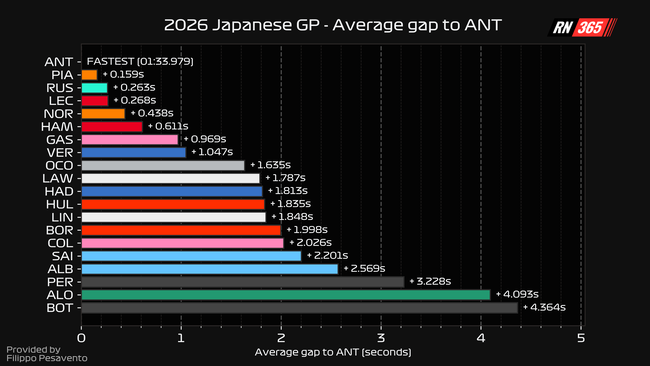
See below for Red Bull’s average lap gap to winner Kimi Antonelli in Japan. Note: Verstappen frequently battled with Pierre Gasly.
The Miami turning point
The team's first real step forward arrived in Miami, where a substantial upgrade package was introduced. It included a rotating rear wing, quickly nicknamed the 'Macarena wing' in the paddock, revised sidepods, a modified steering column following complaints from Verstappen, and a weight saving of roughly six kilograms.
The impact was immediate. Verstappen qualified on the front row in Miami and finished fifth, his best showing of the year to that point.
That rear wing, however, later created a headache. A fault in its locking mechanism, which stopped the airflow from recovering in time under braking, triggering a sudden loss of rear-end downforce, caused problems at both the Red Bull Ring and Silverstone.
Red Bull reverted to a conventional rear wing for Spa while its engineers reinforced the actuator at the factory. The updated version has run without issue since.
A second significant upgrade landed in Austria, covering changes to the sidepod inlets and engine cover cooling alongside further weight reduction.
Verstappen immediately banked P2 at the Red Bull Ring, one and a half seconds behind George Russell. It stands as his best result of the season alongside Madrid.



Problems for Red Bull to solve
It has been a rapid rise, but neither Verstappen nor Red Bull will be satisfied yet. The team currently sits, on average, as the fourth-strongest outfit on the grid. Closing that gap for good means fixing two persistent problems.
The first is energy management. Under the 2026 power unit regulations, which have removed the MGU-H and given the electric MGU-K 350kW, nearly half of total output, more energy needs recovering than is available in a normal braking zone.
That produces what is known in the sport as 'superclipping': the battery runs dry before the end of straights, forcing the MGU-K to stop delivering power so it can recharge.
Mercedes handles this far better than Red Bull, as was clear at Monza, where Verstappen could only keep pace while tucked in the slipstream of Kimi Antonelli and Russell before dropping back on his own.
The second issue may be even more fundamental. Red Bull refers to it internally as car degradation, not ordinary tyre wear but a loss of mechanical and aerodynamic balance over the course of a session or race. The RB22 performs at its best with a full fuel tank.
As fuel weight decreases, the car becomes relatively weaker rather than stronger, exactly where teams normally expect improvement. Rear-end instability increases and the tyres overheat quickly.
It is the opposite of how a race car should behave, and it is a problem Red Bull has been wrestling with for years.
In conclusion, there remains plenty of work to secure regular victories, but the progress made since the season opener leaves Verstappen and Red Bull firmly on the right trajectory.
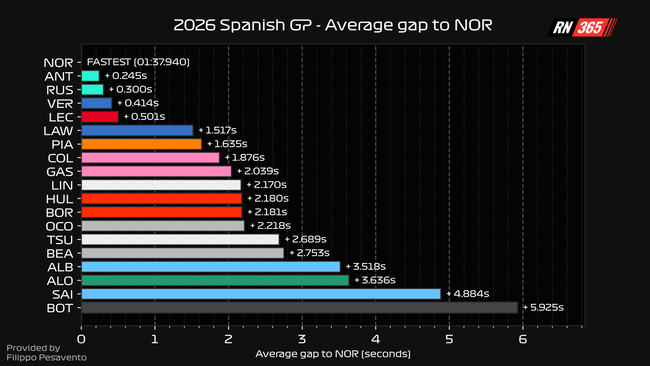
See below for Red Bull’s average gap to the fastest driver, Lando Norris, in Madrid. Note: his poor pit stop is not included. Verstappen’s gap to Mercedes, in particular, is much smaller than it used to be.
Most read

In this article
Never miss a thing from the Formula 1 season! Add the 2026 F1 schedule to your calendar at the touch of a button. Subscribe below and put the dates and times of every race directly on your PC or smartphone, so you don't miss a second from the new season.
Download the F1 calendar Download the F1 calendar
A variant with just the race and qualifying is also available.
Click here to download it..





Join the conversation!