


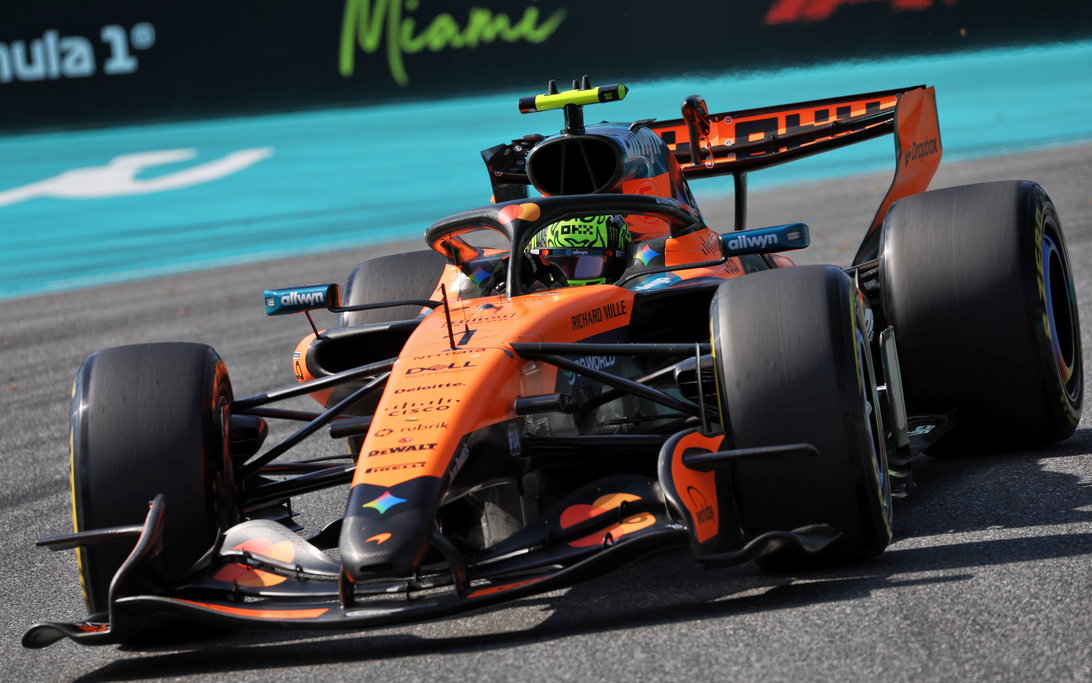
McLaren arrived at Miami International Autodrome carrying a hefty development package that looks set to fundamentally alter the trajectory of its 2026 campaign.
With seven aerodynamic modifications across the MCL40, the Woking-based team delivered the second-largest upgrade haul of the weekend, trailing only Ferrari's ambitious 11-component revision.
Yet for Andrea Stella's team, this represented something far more significant than mere incremental gains: the full realisation of a project that had been quietly brewing since the season opener.
The front end received particular attention, with McLaren's aerodynamicists focusing heavily on the intricate dance between the front wing endplates and the revised nose cone geometry. The standout modification centred on enhanced outwash generation, achieved through carefully sculpted flap profiles at the wing's outermost sections.
Where these elements connect to the endplates, increased curvature now promotes aggressive airflow diversion, fundamentally altering the car's aerodynamic philosophy.
Rear-end modifications proved equally comprehensive, beginning with a complete rethink of the sidepod inlet configuration and undercut geometry. These changes work in harmony with an extensively revised floor design, featuring alterations to both the leading edge profile and the critical lateral surfaces that manage airflow beneath the car.
The engine cover area underwent substantial reshaping to optimise airflow direction towards the rear wing assembly. Most notably, the rear wing endplates now feature sophisticated flow strakes designed to guide air outwards, creating enhanced extraction from the diffuser through improved interaction with the beam wing elements.
According to sources within the paddock, this upgrade package will reach completion at the upcoming Canadian Grand Prix, suggesting McLaren's development pipeline remains fully committed to this aerodynamic direction.



The strategic timing behind McLaren's patient approach
The timing of these modifications reveals McLaren's methodical approach to development throughout the early stages of 2026. Rather than rushing upgrades to circuit, Stella's engineers prioritised understanding their Mercedes power unit integration, a challenge that proved more complex than initially anticipated.
During the opening rounds, McLaren's focus remained firmly fixed on extracting maximum performance from their power unit, a breakthrough they achieved convincingly at the Japanese Grand Prix.
Introducing aerodynamic changes before mastering energy management and power unit optimisation would have compromised their ability to evaluate upgrade effectiveness accurately.
This patient strategy proved vindicated at Miami, where the MCL40 finally demonstrated the performance potential that had remained largely hidden during the season's early phases.
The car now exhibits exceptional balance characteristics across both medium-speed technical sections and high-speed corner combinations, positioning it as a genuine challenger to Mercedes' early-season dominance.
McLaren's development philosophy reflects broader lessons learned from previous seasons, where premature upgrade introduction often masked fundamental setup issues.
By addressing power unit integration first, the team created a stable baseline from which to evaluate aerodynamic modifications, ensuring each component's contribution could be measured accurately rather than lost in the noise of broader performance fluctuations.
Most read




In this article
Never miss a thing from the Formula 1 season! Add the 2026 F1 schedule to your calendar at the touch of a button. Subscribe below and put the dates and times of every race directly on your PC or smartphone, so you don't miss a second from the new season.
Download the F1 calendar Download the F1 calendar
A variant with just the race and qualifying is also available.
Click here to download it..





Join the conversation!