


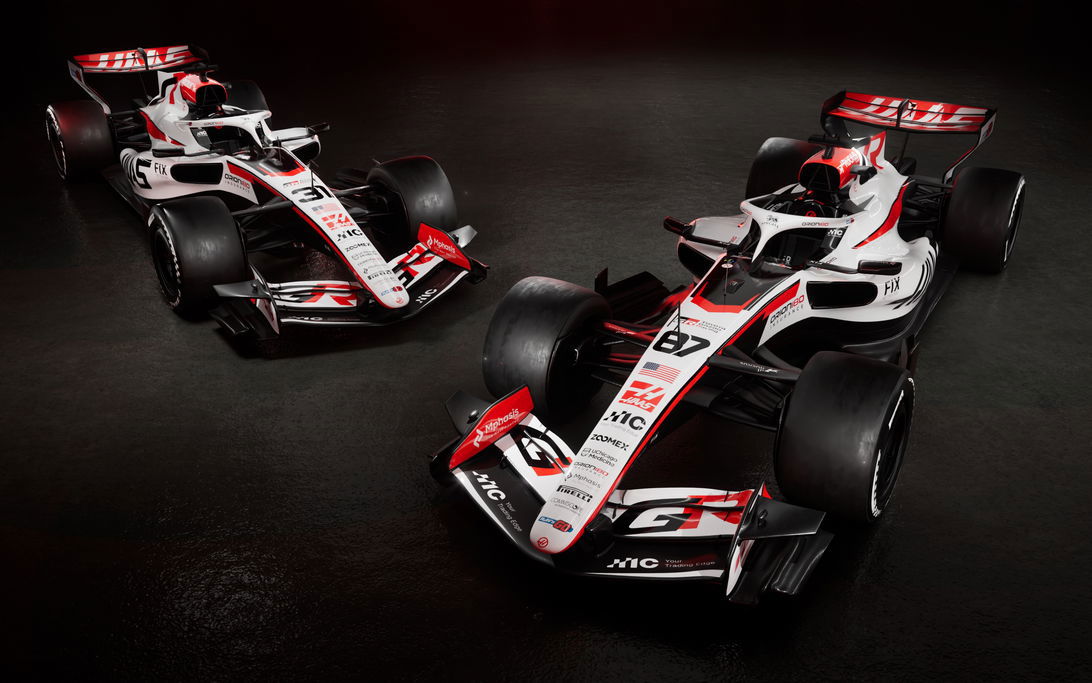
The first images released by Haas of its new VF-26 reveal a car slightly different to those RacingNews365 has so far analysed.
Not entirely from a suspension perspective, as the car adopts a pushrod design at both the front and rear, despite the latter featuring a strong emphasis on anti-squat, with a steep inclination of the upper wishbone.
The nose cone extends beyond the leading edge of the front wing, to which it is connected via two short arched supports. The sidepods feature rather large inlets positioned in the upper section, with a significantly larger cross-section than those seen on other cars.
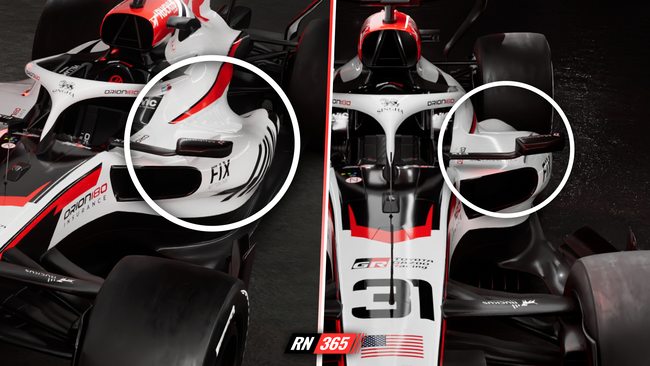
The sidepods, though, feature a very unique design, with the upper section characterised by a channel that increases in depth towards the rear, while the upper front section features gills reminiscent of those on the 2022 Ferrari F1-76.
The undercut under the sides is very accentuated at the front and then narrows towards the rear, making the overall length of the sidepods decidedly long.
View the sidepods below. The text continues after that.
A real leap forward?
The engine cover, at first glance, is misleading, looking like a sort of bazooka vaguely reminiscent of those on the 2024 Red Bull.
Instead, it is characterised by a volume that bends slightly downwards, continuing towards the rear. This gives the visual impression of a hot air vent, with an almost crescent-shaped section that is representative of previous versions of the car.
The design of the bargeboards, in front of the sidepods, is only sketched out, giving the impression, and confirmed on other cars, that this area will be subject to considerable change.
The power unit's air intake is oval in shape and divided into three sections, highlighting the presence of an exchanger at the airbox level and a division of the internal ducts for cooling the ERS.
This could be an indication of what the SF-26's air intake might look like, although it cannot be guaranteed as the Maranello team may have opted for a triangular air intake that mirrors that of the SF-25.
However, this certainly is not a factor capable of creating a difference in performance; if anything, it would simply represent a different integration into the overall aerodynamic concept of the car.
It is interesting to note that the front volume of the chassis does not feature an accentuated scoop, as seen on Red Bull, Racing Bulls, and Audi.
The VF-26, from what has emerged from the initial photos, does not currently appear to be a real leap forward, on a conceptual level.
But, as mentioned at the beginning, it maintains some highly original characteristics in the side area, with generous volumes and radically different profiles.
Also interesting:
The 2026 F1 Cars Revealed: Everything You Need to Know!
Discover how the 2026 F1 regulations will revolutionise the sport, with a shift to movable wings instead of traditional DRS, to the increased electrical power in the hybrid systems, and the introduction of 100% sustainable fuel.
Most read








In this article
Never miss a thing from the Formula 1 season! Add the 2026 F1 schedule to your calendar at the touch of a button. Subscribe below and put the dates and times of every race directly on your PC or smartphone, so you don't miss a second from the new season.
Download the F1 calendar Download the F1 calendar
A variant with just the race and qualifying is also available.
Click here to download it..






Join the conversation!