


Formula 1 returns to the Sepang International Circuit for round 16 of the season, though the race retains its Bahrain Grand Prix branding after Malaysia stepped in as a substitute host.
First adorning the F1 calendar in 1999, the venue has not hosted F1 since 2017, but its history, layout and climate remain as relevant as ever heading into the weekend. Here are five things worth knowing before the lights go out.
1. Tilke's proving ground
Sepang was the first Formula 1 circuit Hermann Tilke built from scratch, arriving after his redesign of Austria's A1 Ring, the track now known as the Red Bull Ring.
The 1999 project set the template for a career that would go on to shape much of the modern calendar, including the Bahrain International Circuit, Shanghai International Circuit, Istanbul Park, Marina Bay Street Circuit, Yas Marina Circuit, Circuit of the Americas, Baku City Circuit and the Jeddah Corniche Circuit.
The Tilke fingerprint is recognisable across those venues: long straights feeding into sharp, low-speed hairpins designed to encourage overtaking, generous paved run-off to satisfy FIA safety requirements, and flowing multi-apex sequences woven around landmark architecture.
Sepang was where that philosophy was first tested at grand prix level, and much of what followed at Shanghai, Istanbul and Baku traces its roots back to Malaysia.
 Malaysian GP
2. (Almost) half a grid of Sepang veterans
Ten of the 22 drivers on this weekend's entry list have raced at Sepang before, a reminder of how long the circuit has been absent from the calendar despite still carrying recent memories for much of the paddock.
Max Verstappen won the Malaysian Grand Prix the last time F1 visited the Sepang International Circuit, just the second of his now 71 victories.
Of the nine drivers racing this weekend who also competed nine years ago, Hamilton returns to the scene of his 2016 heartbreak; and Fernando Alonso, Valtteri Bottas, Carlos Sainz, Nico Hülkenberg, Esteban Ocon, Sergio Perez, Lance Stroll, and Pierre Gasly — who was making his F1 debut in 2017 — all have prior Malaysian Grand Prix starts on their CVs.
3. The weather wildcard
Sepang's return could hardly come at a more volatile time of year. Late September and early October fall squarely within the monsoon transition period in Malaysia, when air temperatures regularly exceed 30 degrees Celsius, humidity climbs above 70 per cent, and violent afternoon thunderstorms can arrive with little warning.
The circuit's history bears this out: the 2009 race was red-flagged due to torrential rain overwhelming the track's drainage, and the 2012 event suffered a similarly lengthy weather-enforced suspension.
Forecasters covering this week's return have flagged a genuine risk of disruption, and teams will be wary of sudden downpours turning a straightforward strategy into chaos inside a handful of laps.
Given the punishing heat and humidity that typically precede those storms, cooling and tyre management will be under scrutiny long before any rain arrives.
4. A circuit built to reward bravery
Sepang's layout has long been rated among the more driver-friendly on the calendar for wheel-to-wheel racing. Its wide track footprint, stretching between 16 and 25 metres in places, combines with two long back-to-back straights funnelling into a tight hairpin at Turn 15, creating a heavy braking zone that has produced countless overtakes over the years.
The corner profile is unusually varied for a single lap: fast, sweeping sequences through Turns 5 and 6 sit alongside tighter, low-speed corners, downhill braking zones and off-camber apexes.
That mix, combined with abrasive asphalt and the tropical heat, makes Sepang notoriously tough on tyres, with particular stress placed on the shoulders through the circuit's sustained high-speed curves.
The blend of overtaking opportunity and physical tyre demand is part of why so many regard Sepang as one of Tilke's finest pieces of work, even after its 2017 departure from the calendar amid falling ticket sales and rising hosting costs.
This weekend offers a rare chance to see whether that reputation still holds up under a modern grid and a 2026-spec car.
5. A history soaked in drama
The Malaysian Grand Prix ran from 1999 to 2017, and few venues on the calendar have produced chaos quite like Sepang did in its very first year.
Eddie Irvine beat Ferrari team-mate Michael Schumacher to the flag in the inaugural race, a result that kept Irvine's title hopes alive heading into the season finale. But the result did not stand unchallenged for long: post-race scrutineering found both Ferraris' bargeboards in breach of dimensional regulations, and stewards disqualified the entire Ferrari one-two, provisionally handing the win to Mika Häkkinen and, with it, the 1999 drivers' championship, before the season had even reached Suzuka.
Ferrari appealed, and the FIA International Court of Appeal ultimately overturned the disqualifications, ruling that manufacturing tolerances and measurement uncertainty meant the bargeboards were not actually illegal. The one-two was reinstated, Irvine's championship lead was restored, and the title fight went down to the wire in Japan.
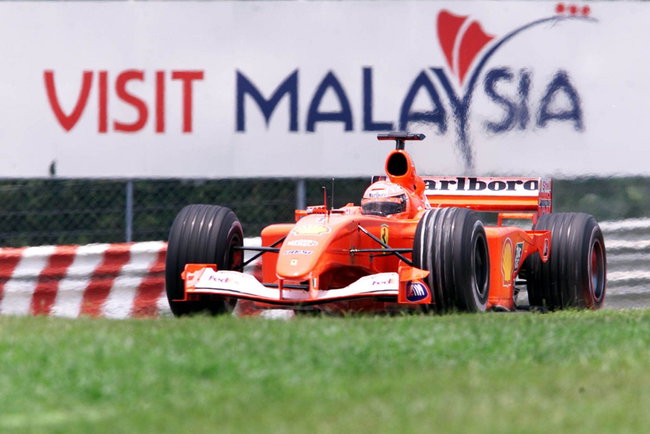
Two years later, Sepang produced a race remembered for entirely different reasons. The 2001 Malaysian Grand Prix, only the second round of that season, turned into a lottery on lap three when a localised tropical downpour combined with oil spilt by Olivier Panis to send cars aquaplaning across the circuit, with both leading Ferraris spinning into the gravel at the same moment.
A lengthy safety car period followed while marshals recovered stranded cars, and Ferrari compounded their misfortune with a bungled 72-second double stack caused by misplaced wet tyres, dropping Schumacher and Rubens Barrichello outside the top ten.
But a bold call to fit intermediates rather than full wets as the track began to dry let both drivers slice back through the field, and Schumacher and Barrichello ultimately crossed the line first and second, an extraordinary recovery from a race that had briefly threatened to be a write-off for the team.
The 2009 edition was infamous for being stopped early due to a violent tropical downpour, with the race called before full distance and Jenson Button's Brawn taking a shortened victory.
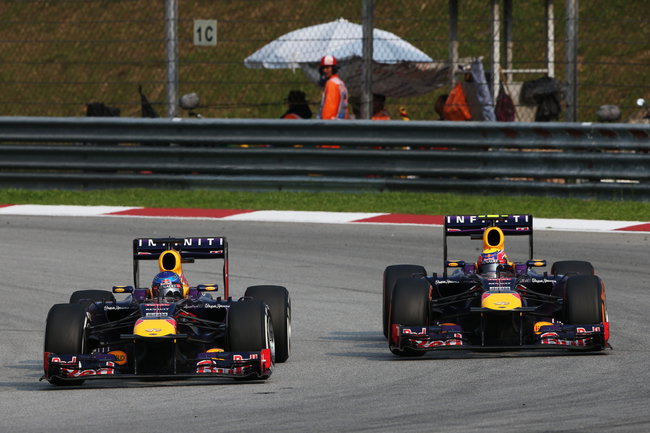
Then came 2013, when Red Bull's Multi 21 team orders controversy erupted: Sebastian Vettel ignored an instruction to hold station behind Mark Webber and passed him regardless, a move Christian Horner later suggested was partly payback for Webber's conduct during their 2012 title fight in Brazil.
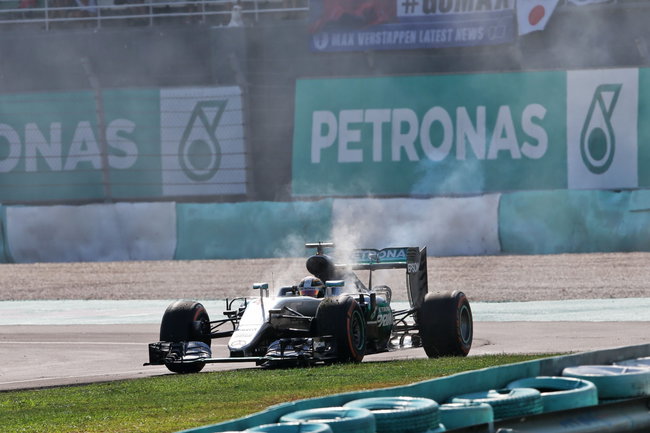
The most consequential Sepang race for the championship picture, though, came in 2016. Lewis Hamilton had qualified on pole and looked set for a crucial win in his fight with Mercedes team-mate Nico Rosberg, only for his power unit to fail with smoke pouring from the rear of his car late in the race.
Mercedes later traced the failure to a crankshaft big-end bearing that gave way without warning after a sudden drop in oil pressure. The result handed Rosberg a 23-point championship lead with five rounds remaining, a 28-point swing from the would-be result, from which Hamilton never recovered. Rosberg went on to claim the title before retiring from the sport days later.
Check out some of those memorable moments below!

Also interesting:
Join RacingNews365's Ian Parkes, Sam Coop and Nick Golding as they look back on the Azerbaijan GP but also look ahead to F1's return this weekend to Malaysia! Rumours linking Christian Horner with a return to the sport is a major talking point.


Most read

In this article
Never miss a thing from the Formula 1 season! Add the 2026 F1 schedule to your calendar at the touch of a button. Subscribe below and put the dates and times of every race directly on your PC or smartphone, so you don't miss a second from the new season.
Download the F1 calendar Download the F1 calendar
A variant with just the race and qualifying is also available.
Click here to download it..





Join the conversation!