


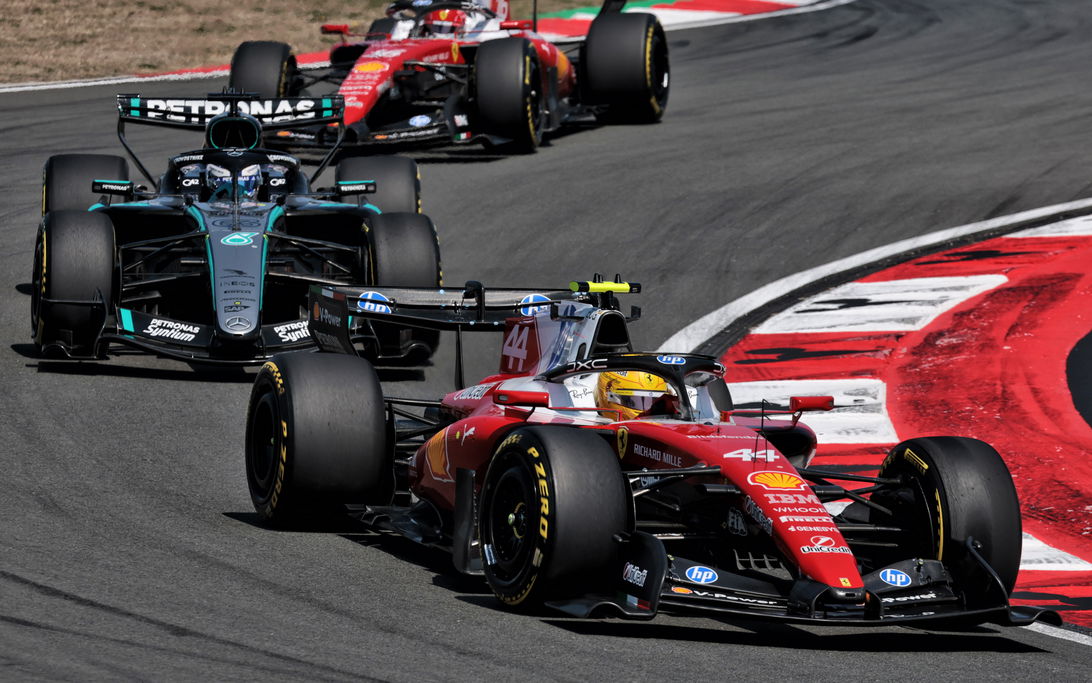
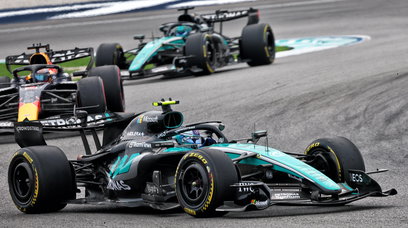
Whilst the Chinese Grand Prix confirmed that Mercedes’ superiority lies primarily, though not exclusively, in its superior utilisation of the power unit, both in terms of electric energy recovery and the power output of the internal combustion engine at high revs, it was equally clear that, for now, the only serious challenger to the Brackley-based team is Ferrari.
Overall, the SF-26 is a competitive car, with excellent vehicle dynamics and aerodynamics that, even with the specification introduced in Bahrain, have already allowed for a good balance to be found.
Essentially, what has emerged highlights how the developments that will follow on the car throughout the season will be aimed at optimising a design that is already sound as things stand. It is therefore reasonable to expect targeted developments aimed at increasing downforce to further improve cornering performance, given that the SF-26’s cornering performance was certainly on a par with that of the W17; indeed, on certain sections of the Shanghai circuit, the Ferrari was faster than the W17.
However, the W17 continues to dominate on the straights. Based on this data, the Scuderia’s engineers have planned to take advantage of the cancellation of the Bahrain and Saudi Arabian Grands Prix, with a second filming day at Monza in April.
The exact date has not yet been announced, but the filming day is expected to take place in the second week of April, with a very specific aim: to make the most of the allocated mileage to test new solutions.
These are not so much, or at least not primarily, focused on the car’s aerodynamics, but rather on analysing different ways of utilising the PU, in terms of recharging, but also in terms of making better use of the turbo, which, as is well known, has a smaller diameter than that adopted by rival engine manufacturers, and Mercedes in particular.
It is therefore a test in which Ferrari seeks, on a track that is particularly challenging in terms of electric recharging, to find the right balance between performance and recharging phases, in order to optimise the engine’s potential.
Not only will various modes be tested, but the engine’s torque curve will also be analysed to find the optimal mix, particularly with a view to circuits where electric management will be crucial. But as mentioned, the torque curve and power delivery of the ICE will also form part of this test, which takes on significant importance in the battle with Mercedes.
Ferrari’s objective will therefore be to arrive in Miami with a car/engine package that has substantially reduced the performance gap that emerged in the first two races compared to Mercedes.
It’s no easy task, but one that they consider essential to achieve in Maranello.
Also interesting:
Join RacingNews365's Ian Parkes, Sam Coop and Nick Golding, as they look back on the Chinese Grand Prix. The trio discuss Lewis Hamilton's praise of the new F1 regulations and Max Verstappen's striking criticism, before debating their own views!
Rather watch the podcast? Then click here!


Most read
Never miss a thing from the Formula 1 season! Add the 2026 F1 schedule to your calendar at the touch of a button. Subscribe below and put the dates and times of every race directly on your PC or smartphone, so you don't miss a second from the new season.
Download the F1 calendar Download the F1 calendar
A variant with just the race and qualifying is also available.
Click here to download it..





Join the conversation!