


Ferrari has demonstrated during F1 pre-season testing in Bahrain that it has embarked on a path of strategic innovation with its SF-26 project.
The two systems seen at Sakhir — namely FTM (Flick Tail Mode) and the rear wing featuring a fully pivoting flap — represent a particularly astute interpretation of the 2026 technical regulations.
Several rivals have already begun assessing the potential advantage offered by the two systems.
Some in the paddock have suggested a gain of at least 8 km/h on the straights from the rear wing alone, while the contribution provided by FTM could prove especially significant in terms of overall lap time.
But is it really so important to quantify the true performance gain at this stage? Or is the greater advantage already tied to the time required for rival teams to replicate the concepts?
The article continues beneath the illustration of Ferrari's rotating rear wing.
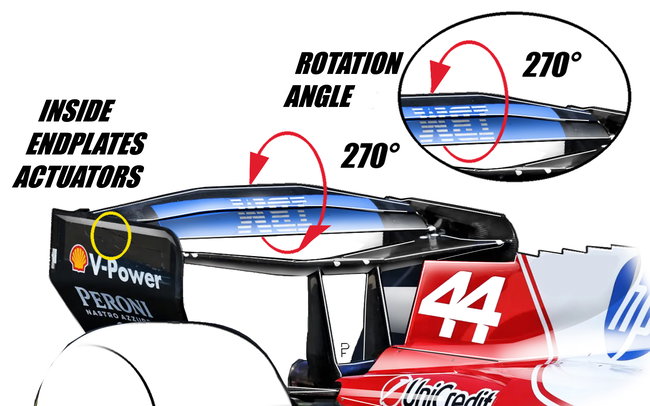
While the estimates that circulated in the Sakhir paddock appear plausible, it is equally important to understand the genuine development timelines behind these components.
The adoption of the fully pivoting rear-wing flap appears to have followed a relatively lengthy design process.
Ferrari's engineers in Maranello were required, at the concept stage, to evaluate how it would integrate within the car’s aerodynamic philosophy.
In particular, they had to assess how the complete rotation of the flap — generating lift — could be effectively exploited to reduce drag and induce diffuser stall.
Why might rivals struggle to copy FTM?
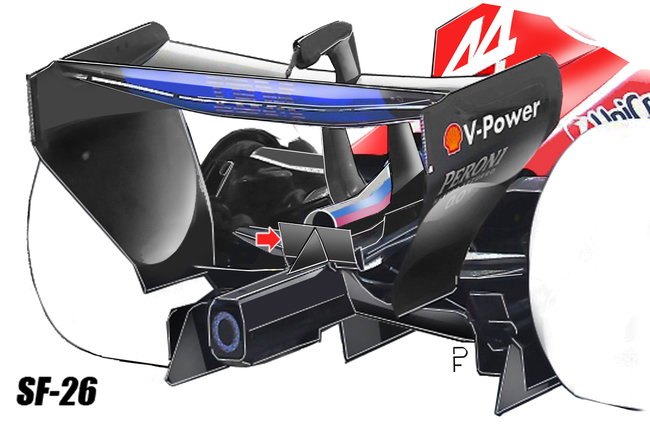
As for FTM, its integration into the SF-26 project is understood to have required nearly six months of work.
Its effectiveness depends heavily on exhaust gas pressure and therefore on the power unit operating mode adopted, including during throttle lift-off phases.
In essence, the complexity of implementing these two solutions is not so much linked to the practical challenge of manufacturing them, but rather to their precise integration within the overall car concept – especially in relation to when the car's aerodynamic philosophy was defined.
Therefore, beyond the mechanical challenges at the gearbox level associated with FTM, the most significant obstacle for rival teams may lie in the extensive preliminary study phase required to incorporate both solutions into their own designs.
Also interesting:
Join RacingNews365's Ian Parkes, Sam Coop and Nick Golding, as they look back on pre-season testing and start to look ahead to the Australian GP! Aston Martin's major issues are a lead discussion, as is Ferrari's lightning starts.
Rather watch the podcast? Then click here!


Get the latest F1 news from RacingNews365 directly in your Google feed! Click on the link below and you’ll see your favourite F1 website appearing even more often. That way, you’ll never miss any news, analyses, interviews, or exclusives.
Follow RacingNews365 on GoogleMost read

Never miss a thing from the Formula 1 season! Add the 2026 F1 schedule to your calendar at the touch of a button. Subscribe below and put the dates and times of every race directly on your PC or smartphone, so you don't miss a second from the new season.
Download the F1 calendar Download the F1 calendar
A variant with just the race and qualifying is also available.
Click here to download it..






Join the conversation!