


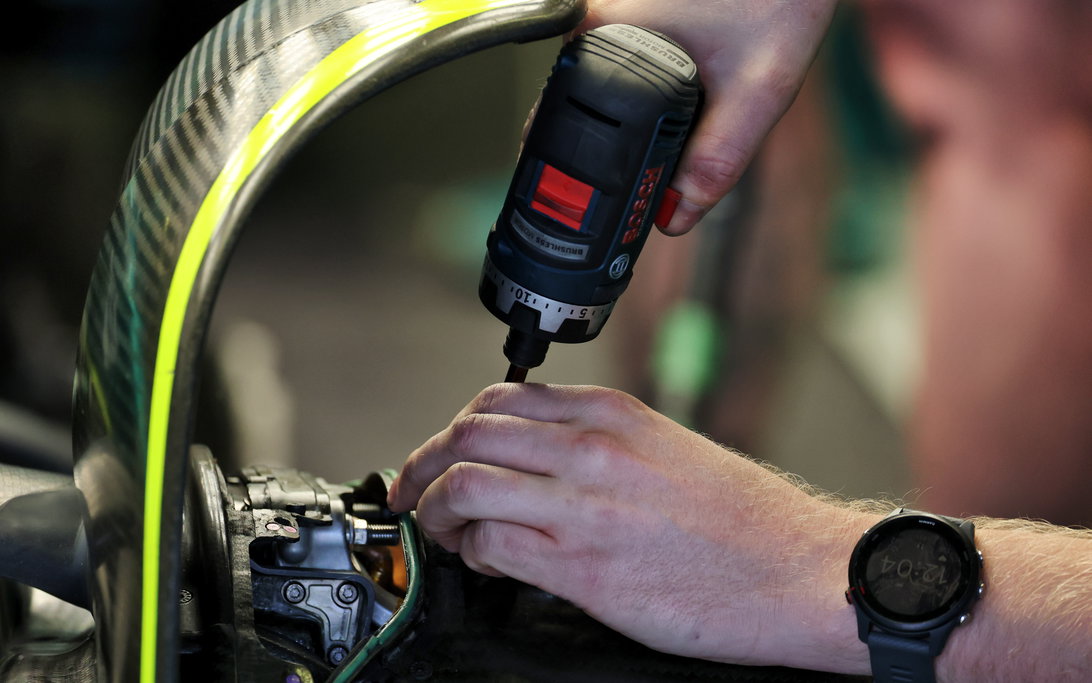
F1 not only provides its technical partners and suppliers with unparalleled visibility and marketing value, but also offers an unmatched opportunity for technological advancement.
Brembo, the brake manufacturer that works with all teams, is a perfect example of how widely F1-perfected technology can be used.
The various technologies, innovations, and achievements stemming from the Italian company's involvement are transferred into other segments of motorsport and everyday road cars.
“Formula 1 is the most challenging championship that we supply, where the technology basically is pushed further every year,” explained Andrea Algeri, racing car market manager of the Italian company in an exclusive conversation with RacingNews365.
“The teams are very fast in trying to push the development, do things even by themselves, and we have to follow them”
[Article continues below]
Technology transfer
Brembo’s technology and expertise are used in numerous racing series, allowing teams in WEC, GT, WRC, Formula E, and MotoGP, among others, to benefit from the work done in the F1 laboratory.
This technology transfer is extensive, even though every racing series has its own unique characteristics.
"For example, in WEC, the components are very close to F1, even if they are not so customised,” said Algeri.
"The solutions are more driven by Brembo compared to F1, where the teams are asking for minimal differences and a lot of customisation of the components.
"The carbon material and the calliper technology are very similar. The brake-by-wire, for example, is even more complicated than F1 because the rules allow you to be more complicated in the sense that the component is more integrated in the car."
Algeri also provided insight into how technology gained in F1 makes its way into the world of road cars. According to the Italian engineer, this transfer comes with its own challenges due to the unique nature of motorsport.
"When the product is good for F1, but you translate it directly without any change on the road car, you still have some problems," he said.
"For example, carbon material needs some temperature to operate and give you the best performance.
"Road car applications need to work at ambient temperature because you are on a highway; you run for several miles without touching the brakes, and then you hit the brakes, and you don't have temperature in this carbon material, so the performance could not be the best.
"However, some modifications in the process allow you to use a similar material with an everyday driver or everyday car with the best performance for that particular application."
[Article continues below]
From F1 to the road cars - and back?
The complications of the technology transfer from racing to public roads obviously require time. Algeri pointed out that this depends entirely on the type of solutions being transferred.
"It could be very fast, but depending on the customer you have, the horizon is at least three to four years," he said.
"This is, I would say, the minimum amount of time that you need to translate one component that is developed in F1 to the standard road car.
"Obviously, it really depends on the example, but even maybe some geometry on the calliper, for example, can be translated quite quickly into a final product. If we talk about carbon materials, it may take even 10 years."
Algeri additionally explained that because the solutions used in F1 are heavily restricted by strict demands and regulations, some road cars today feature brake systems that are technologically more advanced than those in F1 cars.
The explanation is simple: in the world of road cars, engineers are not bound by rigid rules. The brake expert also pointed out that, from time to time, motorsport actually draws inspiration from solutions applied in road cars.
"In some ways, road car applications are now sometimes even more technologically advanced compared to F1," he said. “Why? Because in F1, some areas are limited by the rules."
Also interesting:
Join RacingNews365's Ian Parkes, Sam Coop and Nick Golding as they look back on last weekend's Singapore Grand Prix! Max Verstappen's Marina Bay masterclass is a lead talking point, as is F1's deadline approaching to make a call on how the 2026 season will end.
Rather watch this podcast? Then Click here!


Most read


In this article
Never miss a thing from the Formula 1 season! Add the 2026 F1 schedule to your calendar at the touch of a button. Subscribe below and put the dates and times of every race directly on your PC or smartphone, so you don't miss a second from the new season.
Download the F1 calendar Download the F1 calendar
A variant with just the race and qualifying is also available.
Click here to download it..





Join the conversation!