


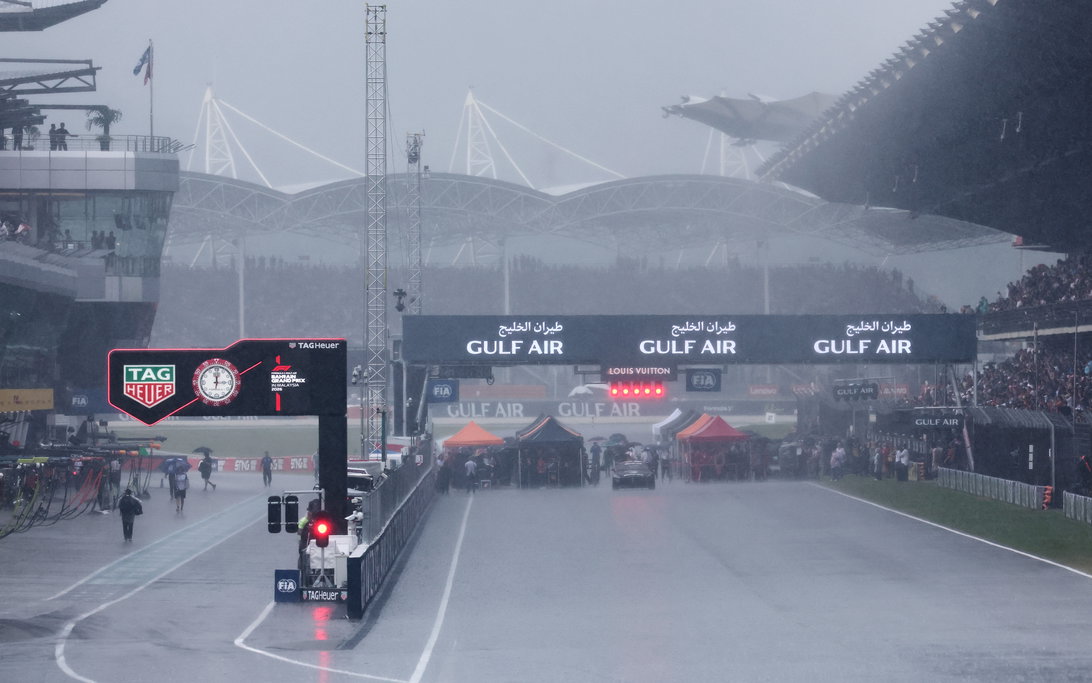
The Bahrain Grand Prix in Malaysia at the Sepang International Circuit was due to get underway at 15:00 local time, but heavy rain and lightning have forced the start to be delayed.
The FIA has confirmed that rain intensity has remained steady, while the medical car has been sent onto the circuit to further assess conditions.
The threat of a shortened race is particularly significant given Sepang's history with extreme weather.
The circuit's scheduled race distance is 56 laps, meaning the current F1 regulations provide four distinct points thresholds that are particularly easy to calculate.
How does the F1 shortened-race points system work?
Under the F1 regulations, points are awarded according to the distance completed by the race leader when the grand prix ends — or is declared.
There is an important change from the old system: F1 no longer simply awards half points for a race that falls short of 75 per cent distance. Instead, there are four levels of points.
For any points to be awarded, the race leader must first complete at least two complete and consecutive laps without a Safety Car or Virtual Safety Car procedure. After that, the points depend on how far the leader has travelled.
With the Bahrain Grand Prix in Malaysia scheduled for 56 laps, the thresholds are particularly straightforward.
Points allocation table
| Position | Under 25% distance | 25% to <50% distance | 50% to <75% distance | 75%+ distance (full points) |
|---|---|---|---|---|
| 1st | 6 points | 13 points | 19 points | 25 points |
| 2nd | 4 points | 10 points | 14 points | 18 points |
| 3rd | 3 points | 8 points | 12 points | 15 points |
| 4th | 2 points | 6 points | 9 points | 12 points |
| 5th | 1 point | 5 points | 8 points | 10 points |
| 6th | 0 | 4 points | 6 points | 8 points |
| 7th | 0 | 3 points | 5 points | 6 points |
| 8th | 0 | 2 points | 3 points | 4 points |
| 9th | 0 | 1 point | 2 points | 2 points |
| 10th | 0 | 0 | 1 point | 1 point |
These are the points available to both the drivers' and constructors' championships.
So, for example, if the race is stopped after 20 laps, the winner would receive 13 points rather than the full 25.
If 30 laps are completed, the winner receives 19 points.
Once the leader has completed 42 laps, or 75 per cent of the scheduled distance, the full allocation is available.
What happens if the race does not reach two laps?
No points are awarded unless the leader completes at least two complete consecutive laps without a Safety Car or VSC period.
That means the FIA cannot simply award points because the cars have taken to the track and completed a few laps behind the Safety Car. The required conditions in the regulations have to be met.
Why is the 56-lap distance important?
The Sepang race distance makes the four thresholds easy to remember.
- 13 laps = below 25 per cent
- 14 laps = 25 per cent
- 28 laps = 50 per cent
- 42 laps = 75 per cent
- 56 laps = full race distance
That means every additional quarter of the race completed can have a significant impact on the championship points available.
For instance, if the rain forces the race to end after 27 laps, the winner scores 13 points. If the field manages just one more lap, the race crosses the 50 per cent threshold, and the winner's haul jumps to 19 points.
The difference between finishing at 27 and 28 laps could therefore be six points for the winner.
Sepang has form when it comes to rain
The possibility of a heavily disrupted race should come as little surprise at Sepang.
Malaysia's tropical climate means thunderstorms and sudden heavy downpours are a regular feature, with the official Malaysian weather service forecasting thunderstorms around Sepang on Sunday and temperatures reaching 33°C.
The circuit is also renowned for producing rapidly changing conditions. Drivers faced dry and extremely hot conditions during Friday and Saturday of this year's event, but the threat of thunderstorms increased as race day approached.
The combination of intense heat, high humidity and tropical storms has historically made predicting the weather at Sepang particularly difficult.
Mercedes' Kimi Antonelli even highlighted the circuit's unusual asphalt as a potential advantage in wet conditions. The highly abrasive, open-surfaced track can allow water to drain between the stones rather than sitting on top of the asphalt, potentially reducing the risk of aquaplaning in ordinary rain.
But a tropical downpour can overwhelm even Sepang's drainage.
What happened at the 2009 Malaysian Grand Prix?
Formula 1 has already experienced one of its most famous weather-affected races at Sepang.
The 2009 Malaysian Grand Prix began in dry conditions, but rain arrived around the quarter-distance mark before developing into a torrential storm.
Drivers struggled as the rain intensified, with standing water eventually making the circuit effectively undriveable. The race was red-flagged after 31 of the scheduled 56 laps, with conditions failing to improve sufficiently for racing to resume.
Jenson Button was declared the winner for Brawn, ahead of Nick Heidfeld and Timo Glock.
Because only 31 of the 56 laps had been completed, the race had not reached the 75 per cent threshold required at the time for full points. The top eight therefore received half of the normal points allocation, as per the regulations at the time.
Button received five points for the victory, rather than 10, while Heidfeld scored four and Glock three.
The race became one of the defining examples of how quickly conditions can deteriorate at Sepang.
Most read







In this article
Never miss a thing from the Formula 1 season! Add the 2026 F1 schedule to your calendar at the touch of a button. Subscribe below and put the dates and times of every race directly on your PC or smartphone, so you don't miss a second from the new season.
Download the F1 calendar Download the F1 calendar
A variant with just the race and qualifying is also available.
Click here to download it..





Join the conversation!