


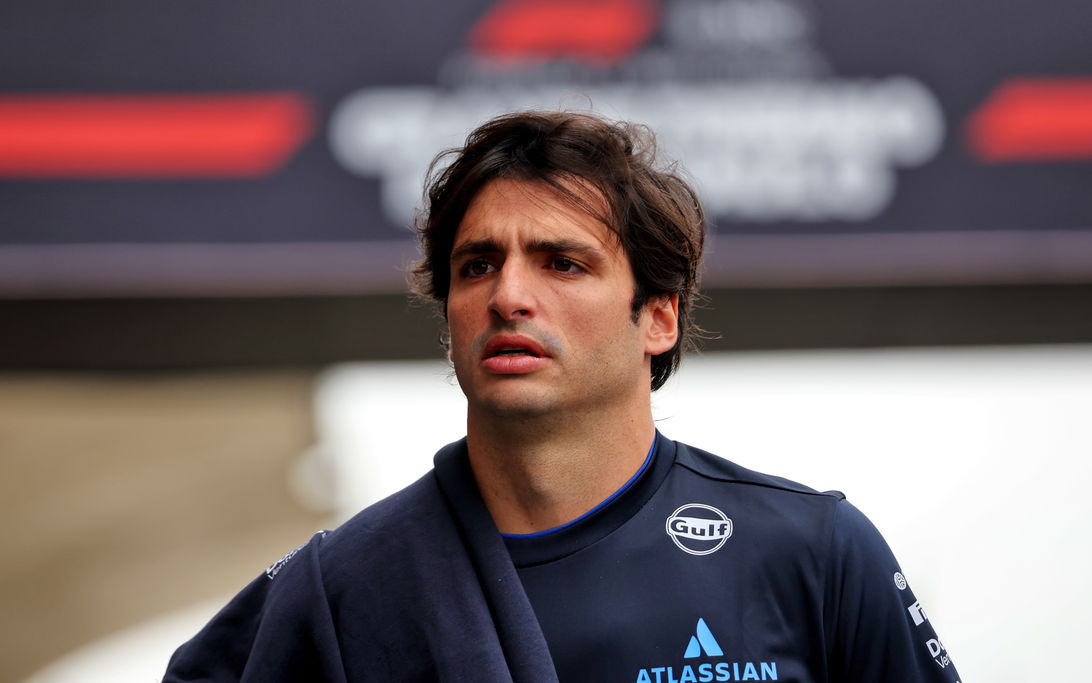
Carlos Sainz believes the recent swathe of drivers joining new teams in F1 and initially struggling has validated his long-held stance that it takes time to adapt to different surroundings.
The Williams driver has been somewhat of a journeyman over his 11 seasons in F1, having raced for Toro Rosso, Renault, McLaren, Ferrari and now the Grove-based squad.
Whilst the Spaniard has tended to help improve every new team he has joined, he has also been outspoken about the often-steep learning curve during the transitional period, particularly recently, ahead of and during the early months of his Williams tenure.
But, with various drivers changing teams for the 2025 campaign after a busy F1 silly season the year before, he can now support his claims with evidence from up and down the paddock.
Liam Lawson was jettisoned out of the second Red Bull seat after just two rounds, having massively struggled to get to grips with the RB21, and Yuki Tsunoda — who switched places with the New Zealander — did not fare much better.
But the most high-profile driver to underwhelm in their debut season with a new team has been the man who replaced Sainz at Ferrari, Lewis Hamilton.
The seven-time F1 drivers' champion's lack of performance and results has been well covered this year, in what was a dismal campaign for himself and the Italian team.
Arguing that "no one really bought" that point of view previously, Sainz highlighted that the hardship endured by others has helped prove him right.
"I’m a driver that, fortunately or unfortunately, has had to change teams quite often," the four-time grand prix winner told F1.com.
"I’ve always been very vocal about how long it takes a driver to adapt to a new team, to extract the last couple of tenths out of the car, and to feel at one with it, but also with your engineers, with the rest of the team."
"I feel like no one really bought that a few years ago when I was saying it.
"When I went from Toro Rosso to Renault, from Renault to McLaren, everyone was like, 'Yeah, but you’re F1 drivers, you can do it'.
"The fact that so many drivers have recently changed teams, and everyone’s realised that it takes time – even the best ones take time to adapt – has kind of proven my point."
Viewed by others:


The best case scenario
Sainz endured a tough start to the year with Williams. Despite showing flashes of pace, he was unable to match Alex Albon and by the summer break had only accumulated 16 points to his team-mate's 54.
However, over the final eight rounds of the campaign, after the Thai driver started the second part of the year well, Sainz outscored him 48 points to three, which included two grand prix podiums and a sprint top three.
As justification for his slow start, the 31-year-old added: "The reality is, with the talent and the speed there is nowadays in F1, when you’re up against Alex Albon in a Williams, Charles Leclerc in a Ferrari, or Max Verstappen in a Red Bull, they know the car by heart, so it’s very difficult to come in and immediately be at that level, as they’re already at the limit.
"In the best case, you can match that and maybe improve it a bit, but in most of the cases when you’re new to a team, you’re going to be a step behind in every free practice session, in every qualifying session, and in every grand prix."
Also interesting:
Join RacingNews365's Ian Parkes, Sam Coop, and Nick Golding as they continue to review the 2025 Formula 1 season. The trio answer crucial questions such as who was the best driver this year, who was the most improved, the biggest disappointment, and much more!
Rather watch the podcast? Then click here!


Most read


In this article
Never miss a thing from the Formula 1 season! Add the 2026 F1 schedule to your calendar at the touch of a button. Subscribe below and put the dates and times of every race directly on your PC or smartphone, so you don't miss a second from the new season.
Download the F1 calendar Download the F1 calendar
A variant with just the race and qualifying is also available.
Click here to download it..





Join the conversation!