


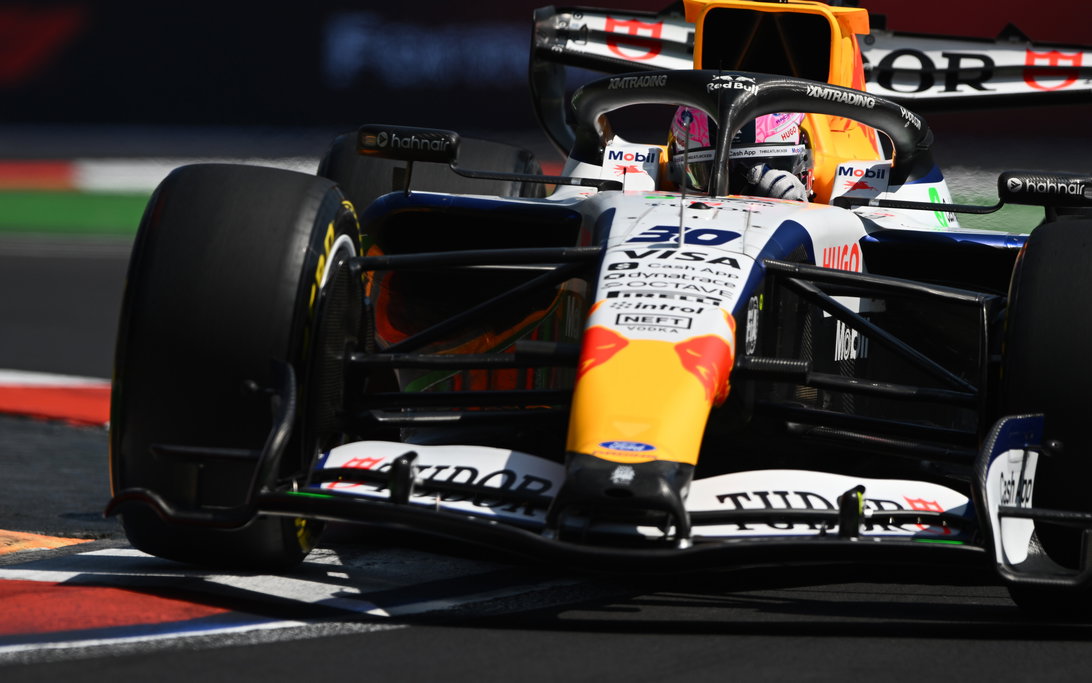
Liam Lawson has been disqualified from qualifying for the Mexico City Grand Prix after stewards ruled his Racing Bulls car breached technical regulations, scrubbing his eighth-place in qualifying.
Lawson entered qualifying already with a one-place grid penalty following his incident with Max Verstappen in second practice on Friday, but now moves all the way to the very back of the grid.
The New Zealander's car was referred to the stewards by the FIA's technical delegate almost immediately after qualifying, who found that Lawson's car was "in breach of the minimum MGU-K power requirement just after crossing the line on his fastest lap in Q2 at 15:47:36.
"This is a breach of Articles C5.12.6 and C5.12.7. The driver maximum power demand and the electrical DC power of the ERS-K were reduced at greater rates than what is permitted by the regulations."
Shortly after the referral, Lawson was summoned to the stewards, with the announcement of his disqualification from qualifying coming shortly after.
Lawson's elimination from the results means he will need the stewards' permission to take part in the race on Sunday. That approval is routinely granted on the basis of times set in free practice, meaning the his participation is not in serious doubt.
Where he lines up is a separate matter. A driver excluded from qualifying normally starts from the back of the grid, unless his Racing Bulls squad breaches parc fermé rules by altering the car's setup or swapping components, in which case he would instead have to start from the pit lane.
Either scenario would hand Racing Bulls the option to fit any tyre compound for the opening stint and introduce power unit parts without the usual grid penalty consequences, an approach teams have used before at the high-altitude Autodromo Hermanos Rodriguez to run an extended first stint on the hard tyre.


The full stewards' reasoning for Liam Lawson disqualification
The stewards' report read: "The stewards heard from the team representatives of Car 30 (Liam Lawson), the driver, the single seater sporting director and members of the FIA technical team including the FIA technical delegate.
"Evidence submitted, which was accepted by all parties present, showed that after the control line at the end of his fastest lap in Q2, the driver did not lift off the power immediately. This resulted in the rate of reduction of MGUK deployment required to achieve the regulated “step down”, not being achieved.
"The team argued that this did not provide any performance advantage however it is clear that non-compliance with the technical regulations is not excused if no performance advantage is gained. Further, these regulations require that a car must comply with them at all times during an event.
"The stewards note in particular that the team self-disclosed the breach however there are a multitude of precedents that require us, despite all mitigating circumstances, to impose a penalty of disqualification where a car does not comply with the technical regulations."
Most read
In this article
Never miss a thing from the Formula 1 season! Add the 2026 F1 schedule to your calendar at the touch of a button. Subscribe below and put the dates and times of every race directly on your PC or smartphone, so you don't miss a second from the new season.
Download the F1 calendar Download the F1 calendar
A variant with just the race and qualifying is also available.
Click here to download it..


Join the conversation!